Finding a cheap eSIM for backpacking doesn't mean sacrificing connectivity. In fact, with the right travel eSIM strategy, you can stay online across multiple countries for less than the cost of a single hotel night.
Whether you're island-hopping in Southeast Asia, train-hopping through Europe, or trekking through Latin America, this guide breaks down the cheapest prepaid eSIM options by region, how to stretch every megabyte, and the roaming traps that quietly drain your budget.
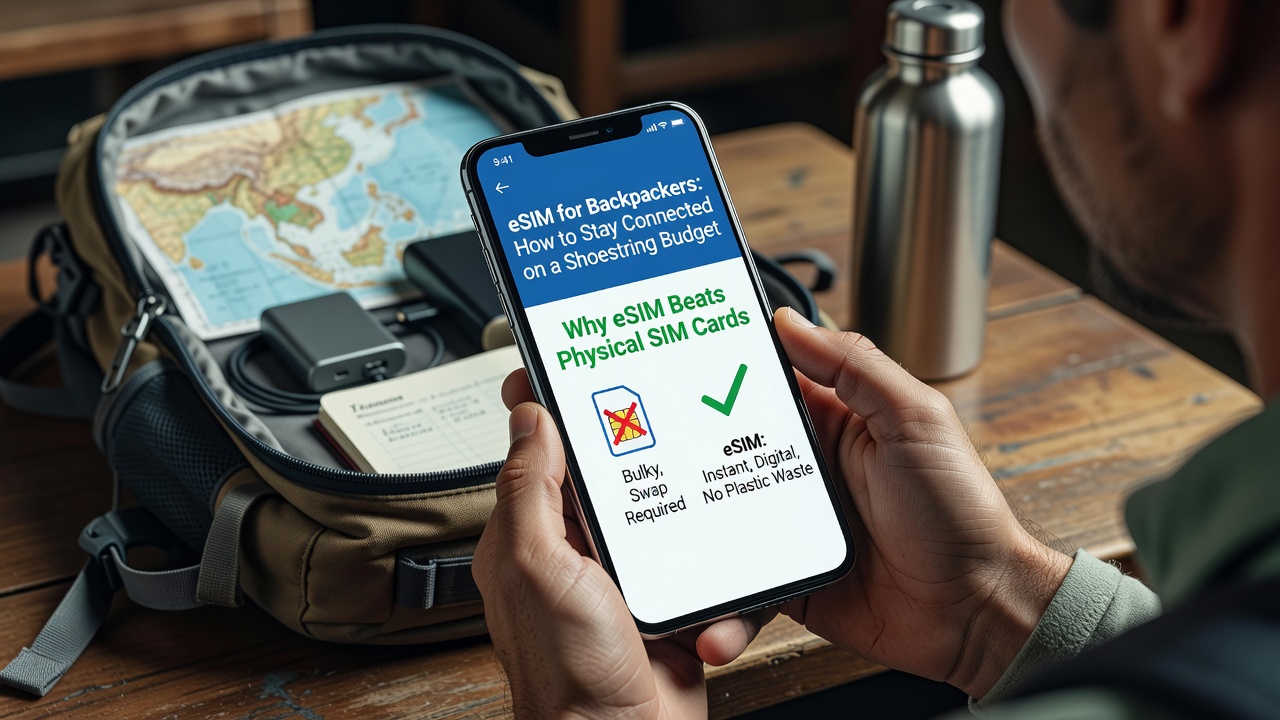
Why eSIM Beats Physical SIM Cards for Backpackers
Traditional SIM cards seem cheap until you factor in the hidden costs: finding a kiosk at every border, language barriers, activation fees, and the inevitable leftover credit when you cross into the next country. An international eSIM eliminates all of that.
With eSIM, you download a data plan before you leave home (or over hostel WiFi when you land), activate it instantly, and skip the SIM-swap dance entirely. For backpackers moving through 3+ countries in a month, this convenience alone saves hours — and the esim plans designed specifically for travelers are often cheaper than local carrier rates.

Cheap eSIM Plans by Region: What Backpackers Actually Pay
Prices vary wildly depending on where you're wandering. Here's a breakdown of the most budget-friendly esim providers and plans across three major backpacking regions.
Southeast Asia
Southeast Asia is the cheapest region for mobile data on the planet. If you're paying more than $3 per GB, you're overpaying.
- Airalo Asia Regional Plan: $5 for 1GB / 7 days, $15 for 3GB / 30 days — covers 12+ Asian countries including Thailand, Vietnam, Cambodia, Laos, and Indonesia
- iWanteSIM SEA Pack: $4 for 1GB / 7 days, $12 for 5GB / 30 days — covers Thailand, Vietnam, Indonesia, Philippines, Malaysia
- SimOptions Local Plans: Thailand AIS 6GB for ~$8 / 15 days; Vietnam Viettel 3GB for ~$5 / 30 days
The best travel esim approach for SEA is a regional plan — one eSIM covers your entire loop through Thailand → Laos → Vietnam → Cambodia without re-purchasing at each border.
Europe
EU regulations cap roaming charges within the EU, making Europe the easiest region for seamless connectivity. But that doesn't mean you shouldn't shop around.
- Airalo Europe Regional Plan: $5 for 1GB / 7 days, $20 for 10GB / 90 days — covers 39 European countries
- Holafly Europe Unlimited: $19 for 3 days, $34 for 7 days, $64 for 15 days — truly unlimited data eSIM, no GB counting
- iWanteSIM EU Plan: $6 for 1GB / 7 days, $25 for 10GB / 30 days — solid mid-range option
- Local carrier eSIMs: Orange Holiday Europe 10GB for ~$18 / 14 days (includes 2 hours of calls)
For a 2-week Euro trip hitting 5 countries, the Airalo 10GB/90-day plan at $20 is the sweet spot. If you're a heavy data user streaming music on long train rides, Holafly's unlimited data eSIM eliminates anxiety about running out.
Latin America
Latin America presents the biggest challenge for budget connectivity — infrastructure varies dramatically between countries, and cross-border roaming is expensive.
- Airalo LatAm Regional Plan: $8 for 1GB / 7 days, $27 for 5GB / 30 days — covers Brazil, Mexico, Colombia, Peru, Argentina, and more
- Holafly Mexico Unlimited: $19 for 5 days, $34 for 10 days — great for a focused Mexico trip
- iWanteSIM LatAm Plan: $7 for 1GB / 7 days, $22 for 3GB / 30 days
- Local options: Brazil Vivo 5GB for ~$6; Mexico Telcel 3GB for ~$10
Latin America is where the per-country vs. multi-country decision matters most (more on that below).
Regional eSIM Plan Comparison Table
| Region | Provider | Plan | Data | Price | Validity | Countries |
|---|---|---|---|---|---|---|
| SE Asia | Airalo | Asia Regional | 3GB | $15 | 30 days | 12+ |
| SE Asia | iWanteSIM | SEA Pack | 5GB | $12 | 30 days | 5 |
| Europe | Airalo | Europe Regional | 10GB | $20 | 90 days | 39 |
| Europe | Holafly | Europe Unlimited | Unlimited | $34 | 7 days | 33 |
| Europe | iWanteSIM | EU Plan | 10GB | $25 | 30 days | 30+ |
| LatAm | Airalo | LatAm Regional | 5GB | $27 | 30 days | 18+ |
| LatAm | Holafly | Mexico Unlimited | Unlimited | $34 | 10 days | 1 |
| LatAm | iWanteSIM | LatAm Plan | 3GB | $22 | 30 days | 12+ |
Multi-Country vs Per-Country eSIM Strategy: Which Saves More?
This is the decision that makes or breaks your esim for travel budget. There's no one-size-fits-all answer — it depends on your route.
Multi-Country Regional Plans: Pros & Cons
- Pros: One purchase covers your entire trip; no re-activation at borders; esim coverage across dozens of countries; best for fast-paced multi-country routes (e.g., 5 countries in 2 weeks)
- Cons: Higher upfront cost; data allowance is shared across all countries; per-GB rate is often higher than local plans
Per-Country Local Plans: Pros & Cons
- Pros: Cheapest per-GB rate; more data for your money; better network priority (local SIMs get bandwidth priority over roaming)
- Cons: Must buy and activate a new plan at every border; leftover data is wasted; time-consuming; some countries require local ID to purchase
Rule of thumb: If you're hitting 3+ countries in under 3 weeks, go regional. If you're spending 2+ weeks in a single country, go local. For a month-long Southeast Asia loop through 4 countries, a regional plan at $15 for 3GB beats buying 4 separate local plans at $5 each — and saves you the hassle.
How to Stretch Your Data Like a Pro Backpacker
The cheapest eSIM is the one you don't burn through. Smart travel data management is the difference between 3GB lasting two weeks or two days. Here's how to make every megabyte count.
Download Offline Maps Before You Leave WiFi
Google Maps, Maps.me, and Organic Maps all let you download entire city or country maps over WiFi. A full country map is typically 200-500MB — download it once over hostel WiFi and navigate offline for the rest of your trip. This alone saves 500MB-1GB per week.
WiFi Optimization: Be Strategic
- Download podcasts, music, and Netflix episodes over hostel WiFi the night before
- Switch messaging apps to WiFi-only mode (WhatsApp, Telegram, Signal all support this)
- Use WiFi calling instead of cellular for voice
- Turn off background app refresh — Instagram and Facebook silently burn 50-100MB/day in the background
- Upload photos only over WiFi (set iCloud/Google Photos to WiFi-only upload)
Data-Saving Browser and App Settings
- Enable Chrome's "Lite Mode" (data saver) — compresses pages by 30-60%
- Disable auto-play videos in social apps
- Use text-only Reddit (old.reddit.com) instead of the app
- Set Google Photos to "Express backup" (lower resolution over cellular)
- Close tabs you're not using — background tabs still fetch data
With these tricks, 1GB can last 5-7 days of normal backpacker use (messaging, maps, occasional browsing, checking bus schedules). Without them, 1GB disappears in 2 days.
Common Roaming Traps Backpackers Fall Into (And How to Avoid Them)
Trap 1: "Free" EU Roaming on Your Home SIM
Many European carriers offer "free EU roaming" — but there's usually a fair-use cap (typically 2-7GB per month). Exceed it and you'll pay €6/MB or more. Solution: Check your home plan's roaming cap before you leave. If it's under 5GB, buy a dedicated travel eSIM instead.
Trap 2: Auto-Roaming Kicking In Before Your eSIM Activates
If your home SIM is still active when you land, your phone may connect to a local carrier automatically and start racking up pay-per-MB roaming charges before you've even left the airport. Solution: Toggle off "Data Roaming" on your home SIM line before your flight. Only turn it on for your eSIM line.
Trap 3: "Unlimited" Plans That Throttle After 1GB
Some providers advertise unlimited data but silently throttle speeds to 128kbps after a small high-speed allowance. At 128kbps, Google Maps takes 30 seconds to load. Solution: Read the fine print. Holafly is one of the few providers with genuinely unlimited high-speed data — most others have a fair-use threshold.
Trap 4: Forgetting to Disable iMessage / RCS Over Cellular
iMessage and RCS use data silently. If you're on a 1GB plan and your phone is sending blue-bubble messages with photo attachments, that data adds up fast. Solution: Switch to SMS temporarily, or only send photos over WiFi.
Trap 5: Letting Cloud Backup Run Over Cellular
One photo backup session over cellular can eat 500MB in minutes. Solution: Set all cloud backups (iCloud, Google Photos, Dropbox) to WiFi-only before you start traveling. This is the #1 cause of "my data disappeared in one day" complaints.
Our eSIM Review: What We Actually Recommend
After testing multiple esim providers across 20+ countries, here's our honest take:
- Airalo — Best overall for regional plans. Reliable coverage, easy app, decent pricing. The go-to for most backpackers.
- Holafly — Best for heavy data users. Truly unlimited plans eliminate data anxiety, but they're pricier per day.
- iWanteSIM — Best budget option. Competitive pricing, good esim coverage, and frequently runs promotions. The best esim choice when every dollar matters.
- SimOptions — Good for local carrier eSIMs when you want maximum data per dollar in a single country.
For a full breakdown, check our esim comparison guide — we compare iwantesim vs airalo, iwantesim vs holafly, and iwantesim vs nomad head-to-head on price, speed, and coverage.
The Bottom Line
You don't need to spend $50+ to stay connected on the road. A cheap eSIM regional plan ($12-27) combined with smart data habits can cover a month of backpacking across multiple countries. The keys: pick the right plan type for your route, download everything you can over WiFi, and kill background data before it kills your budget.
This is your esim guide 2026 for budget travel — print it, bookmark it, or screenshot it before your next trip. Stay connected, stay cheap, and keep wandering.
Frequently Asked Questions
Can I use an eSIM on any phone?
Most phones from 2022 onward support eSIM, including iPhone XS and later, Samsung Galaxy S20+, and Google Pixel 3+. Check your phone's settings for "Add eSIM" or "Mobile Plans" — if the option exists, you're good. Some budget Android phones still lack eSIM support, so verify before you travel.
Is a cheap eSIM reliable enough for navigation and booking?
Yes. The esim plans recommended above connect to the same local carrier networks as physical SIMs — you're just buying data through a reseller. Speed and reliability are identical. The only difference is price and convenience.
What happens if I run out of data mid-trip?
You can top up most eSIM plans directly through the provider's app over WiFi. Airalo, iWanteSIM, and Holafly all support instant top-ups. Alternatively, buy a new plan and activate it — the old one simply expires when its data or time limit is reached.
Should I get an eSIM before I leave or when I arrive?
Buy and install your eSIM before you fly. Activation happens when you connect to a local network at your destination, but having it pre-installed means you'll have data the moment you land — no frantic airport WiFi hunting while jet-lagged.