How to Avoid Roaming Charges When Traveling: 7 Ways to Skip the Bill in 2026
You land in Paris, snap a photo of the Eiffel Tower, and send it to your family group chat. A few minutes of Google Maps to find your hotel, a quick FaceTime call home, and maybe a scroll through Instagram while waiting for your croissant. Harmless, right?
Without a plan, that casual phone use could cost you $200 to $500 in roaming charges — before you even check into your hotel. Major carriers still charge $10 to $25 per megabyte for international data roaming without a plan. To put that in perspective: loading a single modern web page can consume 2-5 MB. That's $20 to $125 just to open one website.
The good news? In 2026, avoiding roaming charges is easier and cheaper than ever. An eSIM data plan can cost as little as $1 to $10 for an entire trip — less than what carriers charge for a single megabyte of pay-as-you-go data. This guide covers seven distinct, practical ways to stay connected abroad without coming home to a bill that costs more than your flight.
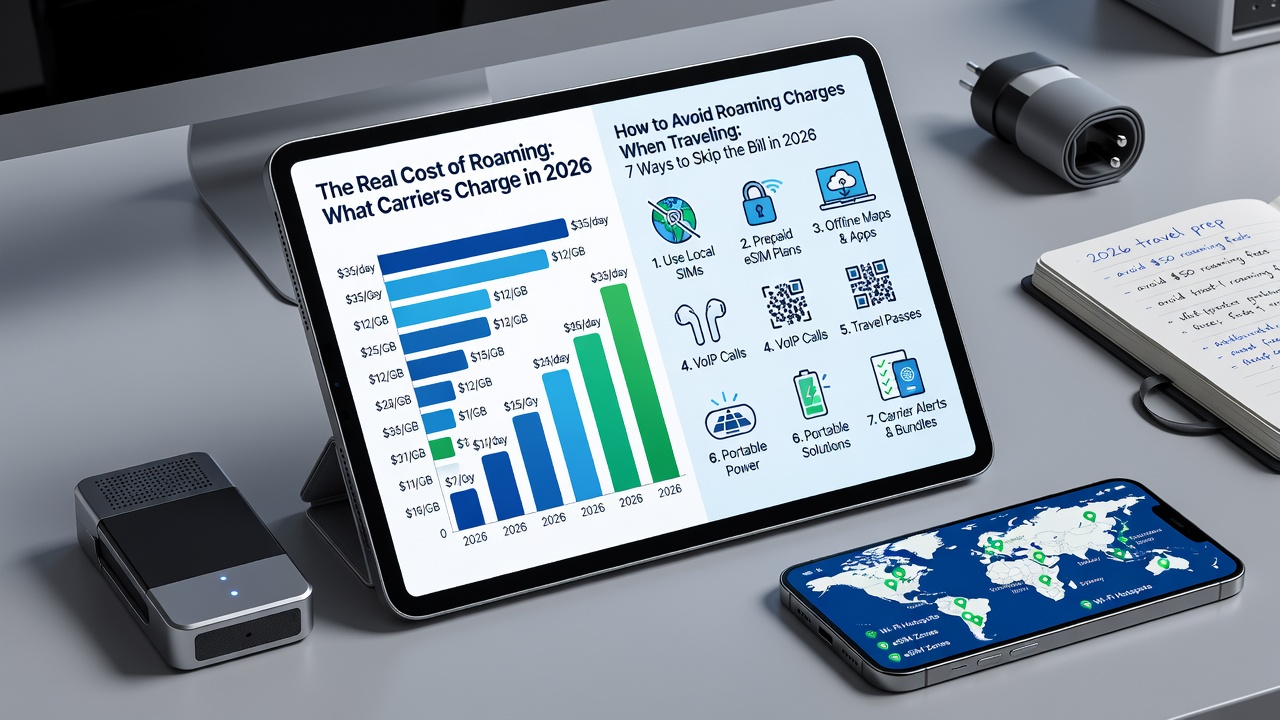
The Real Cost of Roaming: What Carriers Charge in 2026
Before diving into solutions, it's worth understanding the problem. Here's what the major carriers actually charge for international roaming without a plan in 2026:
| Carrier | Pay-As-You-Go Data Rate | Daily Pass Option | Monthly Plan Option | Notes |
|---|---|---|---|---|
| AT&T | $2.05/MB | $12/day (land), $20/day (cruise) | N/A (Day Pass only) | Additional lines $6/day. 210+ countries covered. Unlimited data, talk, text on Day Pass. |
| Verizon | $2.05/MB | $12/day (210+ countries), $6/day (Canada/Mexico) | $100/month (20GB high-speed, 250 min, unlimited text) | TravelPass auto-added on Unlimited Plus/Welcome plans. 5GB high-speed then 3G speeds. |
| T-Mobile | $15/MB (without plan) | $5/day (International Day Pass) | Included in Go5G Next/Plus (up to 5GB high-speed in 215+ countries) | Most plans include free international data at 256kbps. High-speed passes available: $35/10-day, $50/30-day. |
| Vodafone (UK) | £3-£6/MB outside Europe | £6/day (Europe), £6/day (World) | Included in select plans (83+ destinations) | Roaming in EU regulated. Outside EU, rates vary significantly by destination. |
| Orange (France) | €10-€15/MB outside EU | €5-€10/day | €15-€30/month add-on | EU roaming free under regulation. Outside EU, pay-per-use rates apply. |
| eSIM (generic) | N/A | N/A | $1-$10 for 1-5GB (7-30 days) | Data-only in most cases. Works alongside your home SIM. No contract, no carrier lock-in. |
Sources: AT&T International Day Pass page (2026), Verizon TravelPass FAQs (2026), T-Mobile International Roaming Plans page (2026). Pay-as-you-go rates confirmed via carrier official documentation.
The math is stark: using 100MB of data at Verizon's pay-as-you-go rate costs $205. The same 100MB through an eSIM costs roughly $0.20 to $1.00. That's a 200x to 1,000x difference.
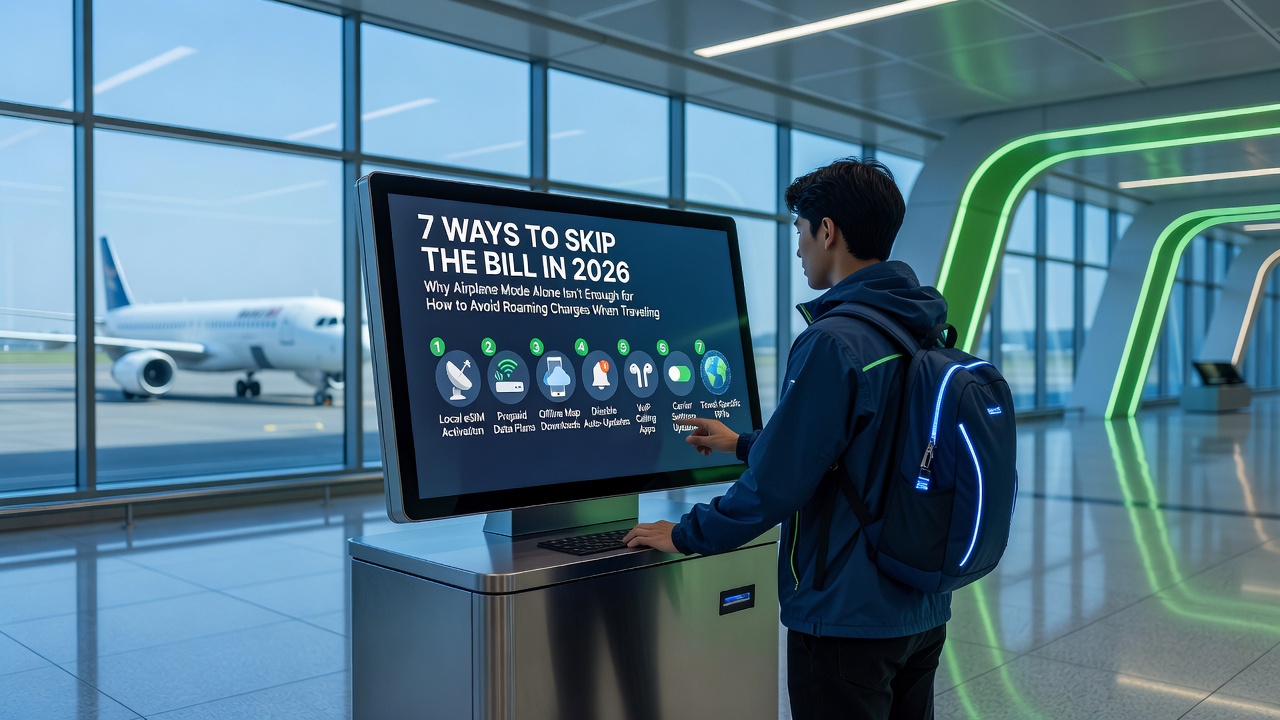
Why Airplane Mode Alone Isn't Enough
Many travelers assume that putting their phone in airplane mode is a complete solution. It's not — and here's why:
- Airplane mode kills all connectivity. No maps, no ride-sharing apps, no translation tools, no restaurant reservations. You're effectively carrying a brick with a camera.
- WiFi isn't everywhere. Public WiFi is unreliable, often slow, and frequently requires sign-ups, SMS verification (which you can't receive in airplane mode), or payment. In many countries, free public WiFi is scarce outside major hotels and cafes.
- Emergency situations. If you need to call a local number, contact your hotel, or handle a travel disruption, airplane mode leaves you stranded.
- Background data traps. Even if you briefly disable airplane mode to check something, apps can consume data in the background — email syncs, app updates, cloud backups — triggering roaming charges before you realize it.
Airplane mode is a temporary tool, not a travel strategy. The real solution is having affordable connectivity that doesn't bankrupt you. Here are seven ways to achieve that.
7 Ways to Avoid Roaming Charges in 2026
1. Use an eSIM — The Primary Solution ($1-$10)
An eSIM (embedded SIM) is a digital SIM card built into most modern smartphones. Instead of swapping physical SIM cards, you download a data plan directly to your phone. In 2026, eSIMs are the single most cost-effective way to avoid roaming charges.
How it works:
- Purchase an eSIM data plan before your trip (or on arrival) from a provider's app or website
- Install it via QR code or app in under 2 minutes
- Your phone now has two lines: your home number (for calls/texts) and the eSIM (for data)
- Set the eSIM as your data line and keep your home line active for calls (using WiFi Calling to avoid charges)
Typical eSIM pricing in 2026:
- 1GB for 7 days: $1-$3
- 3GB for 15 days: $3-$7
- 5GB for 30 days: $5-$10
- 10GB for 30 days: $8-$15
- Unlimited data (speed-capped after fair use): $15-$30 for 30 days
Key advantages:
- Massive cost savings: $1-$10 vs. $12-$20/day carrier passes or $2-$15/MB pay-as-you-go
- Instant activation: No store visit, no physical SIM delivery
- Keep your number: Your home SIM stays active for receiving calls and texts
- Multi-country coverage: Many eSIMs cover entire regions (Europe, Asia, Latin America) in one plan
- No contract: Pay only for what you need, when you need it
Compatibility: Most phones released after 2019 support eSIM, including iPhone XR and newer, Google Pixel 3 and newer, Samsung Galaxy S20 and newer. Check your phone's settings for "Add eSIM" or "Add Cellular Plan" to confirm.
2. Buy a Local SIM Card
If your phone doesn't support eSIM, a local physical SIM card is the next best option. In most countries, you can buy a prepaid SIM at the airport, convenience stores, or carrier shops for $5-$20 with generous data allowances.
Pros:
- Local rates — often the cheapest per-GB option
- Includes a local phone number for calls within the country
- Widely available in most destinations
Cons:
- You lose access to your home number (unless using a dual-SIM phone)
- Requires finding a store, potential language barriers
- SIM registration may require passport/ID in some countries
- One SIM per country — inconvenient for multi-country trips
Best for: Single-country trips of 1+ weeks where you need a local number.
3. Go WiFi-Only with Offline Maps
For budget travelers or short trips, relying entirely on WiFi combined with offline tools can work — if you prepare properly.
Essential offline tools:
- Google Maps offline: Download city/region maps before your trip. Navigation works without data.
- Google Translate offline: Download language packs for text and camera translation without internet.
- Offline entertainment: Download Netflix shows, Spotify playlists, and podcasts before departure.
- Maps.me or Organic Maps: Fully offline navigation apps with points of interest.
Limitations:
- No real-time transit updates, traffic, or ride-sharing
- Can't make calls or send texts without WiFi
- Restaurant reservations, ticket bookings, and last-minute changes require WiFi
- Emergency communication is limited
Best for: Short trips (1-3 days), travelers on extremely tight budgets, or as a backup strategy alongside another method.
4. Use Your Carrier's International Plan (When It's Worth It)
Carrier international plans have improved significantly, and in some scenarios they're actually the best choice:
When carrier plans make sense:
- T-Mobile Go5G Next/Plus: If you're already on these plans, you get up to 5GB of high-speed international data in 215+ countries included at no extra cost. This is genuinely one of the best deals in mobile.
- Short trips (1-3 days): AT&T's $12/day or Verizon's $12/day TravelPass can be simpler than buying an eSIM for a weekend trip — especially if you need to make calls.
- Multi-line families: AT&T charges $6/day for additional lines on International Day Pass. A family of four pays $30/day total, which can be competitive with buying four separate eSIMs.
- Cruise travel: AT&T's $20/day Cruise Day Pass and Verizon's $20/day Cruise Daily Pass are often the only reliable options at sea, where eSIMs and local SIMs don't work.
When carrier plans are a bad deal:
- Trips longer than 5-7 days (daily fees add up fast)
- Data-heavy usage (most daily passes throttle after 500MB-5GB)
- You don't need to make traditional phone calls
5. Use WiFi Calling and Texting
WiFi Calling lets you make and receive calls and texts over WiFi using your regular phone number — without triggering roaming charges. This is a powerful complement to any data strategy.
How to use it:
- Enable WiFi Calling in your phone settings before leaving home
- When connected to WiFi, calls to your home country are typically free
- Text messages (SMS) sent over WiFi Calling are treated as domestic
- On iPhone, WiFi Calling can even work over the eSIM's cellular data connection ("WiFi Calling over Cellular Data")
Important caveats:
- WiFi Calling to non-US numbers may incur international long-distance charges
- Not all carriers support WiFi Calling abroad — check before you go
- Quality depends on WiFi connection strength
Best for: Travelers who need to stay reachable on their home number but use eSIM or local SIM for data.
6. Airplane Mode + WiFi Strategy (Done Right)
Airplane mode isn't useless — it's a tool that needs to be used strategically. The key is combining it with WiFi and preparation:
The smart airplane mode strategy:
- Enable airplane mode before takeoff — not after you land. This prevents your phone from connecting to foreign towers the moment you touch down.
- Turn WiFi back on while keeping airplane mode active. This lets you use hotel/airport/cafe WiFi without cellular exposure.
- Download everything in advance: maps, translations, boarding passes, entertainment.
- Use messaging apps over WiFi: WhatsApp, iMessage, Signal, and Telegram all work over WiFi without cellular service.
- Schedule "connectivity windows": If you have an eSIM or local SIM, turn off airplane mode at specific times to check messages and update maps, then go back to airplane mode to avoid background data drain.
What this strategy doesn't solve: spontaneous navigation, ride-sharing, real-time translation, emergency calls, and the general friction of being disconnected most of the time.
Best for: Travelers who want to minimize data usage while still having occasional connectivity through an eSIM or local SIM.
7. Rent a Portable WiFi Hotspot
Portable WiFi hotspots (also called "pocket WiFi" or "MiFi") are small devices that create a personal WiFi network using a local cellular data connection. You connect your phone to it like any WiFi network.
How it works:
- Rent a hotspot device before your trip (pick up at airport or have it delivered)
- The device connects to local cellular networks and broadcasts WiFi
- Connect multiple devices (phone, tablet, laptop) simultaneously
- Return the device after your trip
Typical pricing:
- $5-$10 per day for unlimited or high-cap data
- Often cheaper than carrier daily passes for groups
- Available in most major travel destinations (Japan, Europe, Southeast Asia especially)
Pros:
- Multiple devices share one connection
- No phone configuration needed — just connect to WiFi
- Keeps your home SIM active for calls/texts
Cons:
- Another device to carry and charge
- Must be returned (deposit often required)
- More expensive than eSIM for solo travelers
- Limited availability in some regions
Best for: Groups or families traveling together, or destinations like Japan where pocket WiFi rental infrastructure is excellent.
Method Comparison at a Glance
| Method | Cost (Typical) | Best For | Keeps Your Number? | Setup Effort |
|---|---|---|---|---|
| eSIM | $1-$10 | Most travelers, any trip length | Yes (dual-SIM) | Low (2 min setup) |
| Local SIM | $5-$20 | Single-country, 1+ week trips | No (unless dual-SIM) | Medium (find store) |
| WiFi-Only + Offline | $0 | Ultra-budget, very short trips | Yes | High (prep needed) |
| Carrier Int'l Plan | $5-$12/day | Short trips, cruise, T-Mobile users | Yes | Low (pre-enabled) |
| WiFi Calling | $0 (with WiFi) | Supplement to data method | Yes | Low (enable in settings) |
| Airplane Mode + WiFi | $0 | Supplement, data minimization | Yes | Low |
| Portable WiFi Hotspot | $5-$10/day | Groups, families, Japan/Asia | Yes | Medium (pickup/return) |
How to Choose the Right Method for Your Trip
With seven options, here's a simple decision framework:
- You have a modern smartphone and want the cheapest option: Go with an eSIM. At $1-$10 for a trip's worth of data, it's unbeatable value.
- You're on T-Mobile Go5G Plus/Next: You already have free international data. Use it, and supplement with an eSIM if you need more than 5GB of high-speed data.
- You're traveling for 1-3 days: A carrier daily pass ($12/day) may be simpler than setting up an eSIM — the convenience might be worth the extra cost.
- You're traveling with family: Compare carrier multi-line daily passes vs. individual eSIMs vs. a portable WiFi hotspot. For a family of four on AT&T, the $30/day total ($12 + $6 + $6 + $6) may beat buying four eSIMs.
- You're going on a cruise: Carrier cruise passes ($20/day) are often the only reliable option. eSIMs and local SIMs don't work at sea.
- You need a local phone number: A local SIM card gives you a local number for restaurant reservations, local contacts, and services that require SMS verification.
The Bottom Line
Roaming charges in 2026 are a choice — not an inevitability. The carriers still charge $2 to $15 per megabyte for pay-as-you-go data, but you never have to pay those rates. An eSIM for $1 to $10 completely replaces the need for expensive international roaming packages, and when combined with WiFi Calling and smart airplane mode usage, you can stay fully connected abroad for less than the cost of a single airport meal.
Before your next trip, take five minutes to check if your phone supports eSIM, download offline maps for your destination, and enable WiFi Calling. Your future self — and your credit card statement — will thank you.
Frequently Asked Questions
Does airplane mode completely prevent roaming charges?
Yes, airplane mode prevents your phone from connecting to any cellular network, which means no roaming charges. However, it also means no connectivity at all — no maps, no calls, no messages — unless you manually turn WiFi back on. The risk is that if you accidentally disable airplane mode, even briefly, background data can trigger charges.
Can I use an eSIM and keep my regular phone number?
Yes. Most modern phones support dual-SIM functionality, meaning you can have your home SIM active (for calls and texts) while using an eSIM for data. On iPhones, you can even enable "WiFi Calling over Cellular Data," which routes your home number's calls through the eSIM's data connection — effectively giving you full functionality without roaming charges.
How much data do I actually need when traveling?
For a typical one-week trip with moderate usage (maps, messaging, social media, web browsing, occasional video), 3-5GB is usually sufficient. Heavy users (streaming video, video calls, large file uploads) may need 10GB+. Light users who rely on WiFi at hotels can get by with 1-2GB.
Are eSIMs safe and reliable?
Yes. eSIMs use the same cellular networks as physical SIM cards. The technology is built into your phone's hardware and is actually more secure than physical SIMs (they can't be physically stolen or swapped). Choose reputable eSIM providers with good reviews and clear pricing.
What's the cheapest way to make calls home from abroad?
Use WiFi Calling (free to US numbers on most carriers) or internet-based apps like WhatsApp, FaceTime, Skype, or Zoom. If you need to call a non-US number, check your carrier's international long-distance rates or use an app like Skype for low per-minute rates.