
Why Your eSIM Choice Makes or Breaks Your Nomad Life
Picture this: you've just landed in Chiang Mai after a 14-hour flight. Your client expects a Zoom call in 45 minutes. You're standing in the airport, jet-lagged, trying to buy a physical SIM card from a kiosk where nobody speaks English — and the queue is 12 people deep.
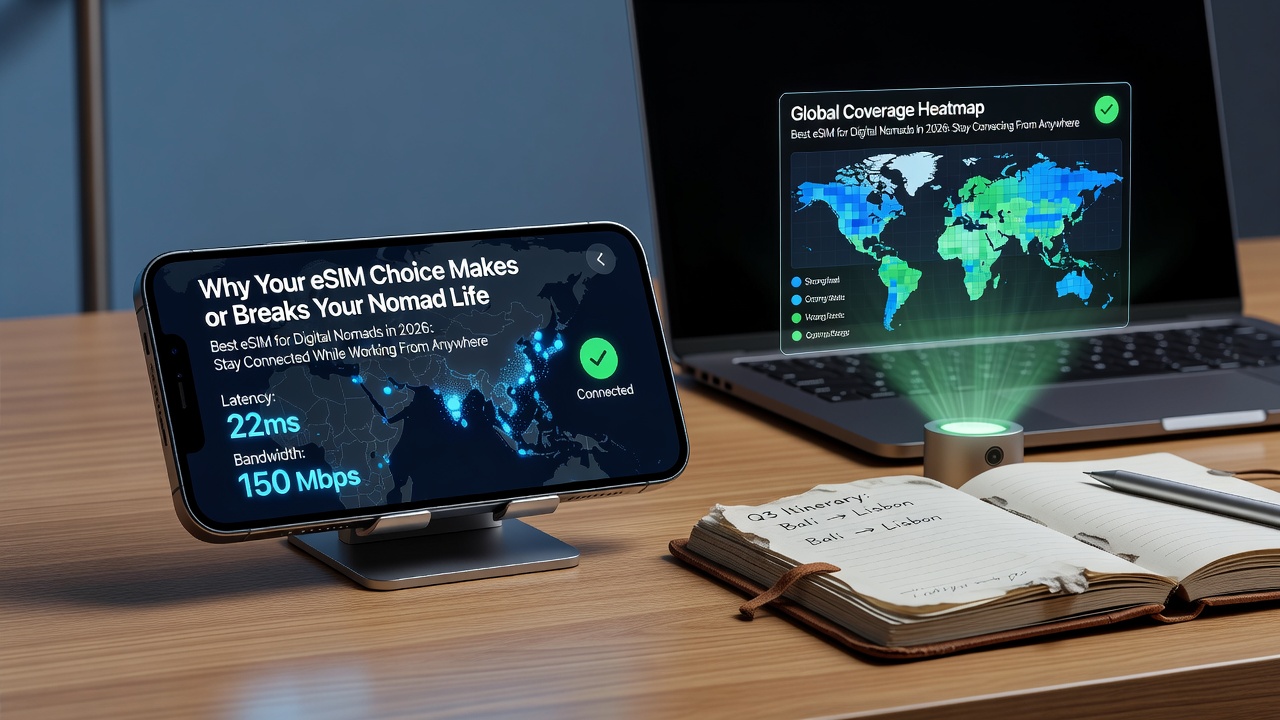
That's the old way. In 2026, over 40 million digital nomads worldwide have made eSIM technology as essential as their laptops. An eSIM (embedded SIM) is a programmable chip built directly into your device that lets you download carrier plans in minutes — no physical card swapping, no language barriers, no lost SIM trays. For remote workers managing client calls across time zones, attending virtual meetings from Bali co-working spaces, or uploading deliverables from Lisbon cafés, consistent connectivity isn't a luxury — it's your livelihood.
But here's the catch: the eSIM marketplace has exploded. New providers launch monthly, pricing structures vary wildly, and what works flawlessly in Barcelona might leave you stranded in Bogotá. This guide cuts through the noise with 2026-specific data, real-world pricing, and practical recommendations tailored to how digital nomads actually work.
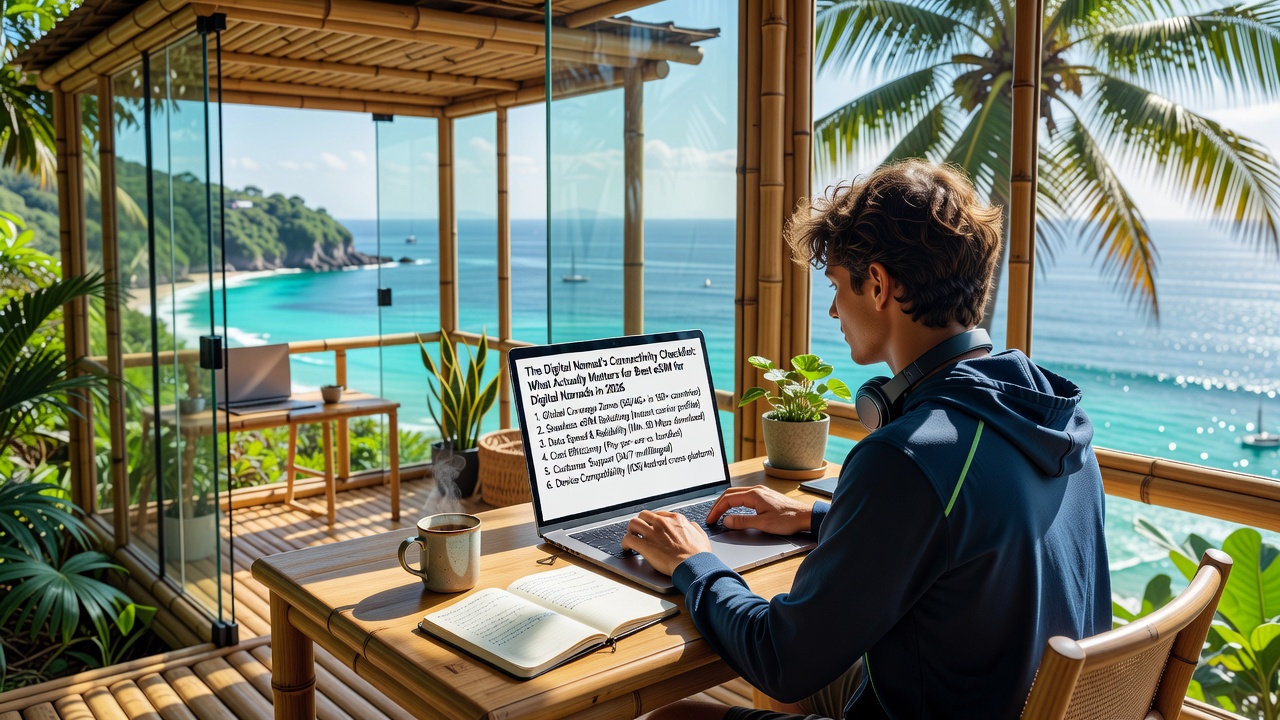
The Digital Nomad's Connectivity Checklist: What Actually Matters
Before comparing providers, let's establish what remote workers need from an eSIM — because your requirements are fundamentally different from a two-week vacationer's.
Data Requirements for Remote Work
If you're working remotely, your data consumption dwarfs the average traveler's. Here's what typical remote work activities consume:
- Zoom / Google Meet video calls: 1.5–2.5 GB per hour for HD video; 800 MB per hour for standard quality
- Slack / Teams messaging + file sharing: 200–500 MB per day with moderate use
- Cloud backups (Dropbox, Google Drive): 1–5 GB per sync session depending on file sizes
- Streaming music while working: 150 MB per hour (Spotify high quality)
- General browsing, email, research: 500 MB–1 GB per day
- Git pushes / code deployments: 100–500 MB per day for active developers
Realistic monthly data budget for a full-time remote worker: 30–50 GB minimum. If you do daily video calls and stream content after work, budget 50–80 GB. Content creators uploading 4K video should plan for 100+ GB monthly.
Hotspot and Tethering: The Dealbreaker Feature
Many digital nomads work from laptops, not phones. This makes hotspot/tethering support non-negotiable. Unfortunately, not all eSIM providers allow it:
- Holafly: Single-device only — no tethering to laptops. This is a dealbreaker for laptop-dependent workers despite their unlimited data.
- Airalo: Hotspot supported on most plans. Works reliably for tethering to laptops and tablets.
- Nomad: Full hotspot support across plans. Multi-device connectivity is a core feature.
- Saily: Hotspot supported. Works well for tethering with built-in VPN protection.
- Ubigi: Hotspot supported, plus IoT device connectivity for smart home setups.
Bottom line: If you work from a laptop, cross Holafly off your list unless you're willing to work exclusively from your phone — which, for most professionals, is unrealistic.
Top eSIM Providers for Digital Nomads in 2026: Head-to-Head
1. Airalo — Best All-Rounder for Budget-Conscious Nomads
Airalo remains the market leader in 2026 with coverage across 200+ countries and the most competitive per-GB pricing. Their regional plans consistently undercut competitors by 30–40% on data costs, making them the go-to for nomads who track every gigabyte.
Standout features: Pay-as-you-go flexibility with no subscriptions; data rollover on select plans; intuitive app interface that makes installation straightforward even for first-time eSIM users; Airmoney loyalty program earning up to 10% cashback.
Real-world performance: Excellent connectivity in Asia and Europe. Some African and South American destinations show occasional network instability. Customer support averages 24–48 hour response times during peak periods.
Best for: Budget-conscious nomads hopping between multiple countries who want maximum flexibility without commitment.
2. Nomad — Best for Multi-Country Border Hoppers
Nomad has carved a distinctive niche by prioritizing genuine flexibility for nomads who traverse multiple countries monthly. Their multi-country plans allow activation across 70+ countries with a single purchase — no juggling multiple eSIM profiles when crossing borders.
Standout features: Intelligent network-switching technology that automatically connects to the strongest available carrier in each country; supports tablets, laptops, and smartwatches beyond just smartphones; mid-month plan adjustments without penalties.
Real-world performance: Maintained consistent connectivity during border crossings in comparative testing across 25 countries. Customer service can lag during peak travel seasons (24–48 hours for complex issues).
Best for: Nomads crossing borders frequently — especially those moving through Schengen countries or Southeast Asian nations in quick succession.
3. Holafly — Best for Unlimited Data (With a Big Caveat)
Holafly's flagship offering is genuinely unlimited 4G/5G data without throttling or fair-use policies — a rare advantage. Real-world testing across 25 countries shows consistent 50–80 Mbps download speeds in urban areas.
The caveat: No hotspot/tethering support. You cannot share your connection to a laptop. For nomads who work primarily from phones (social media managers, some content creators), this is fine. For everyone else, it's a dealbreaker.
Pricing: Ranges from $19 for 5 days to $87 for 90 days in popular regions like Europe. While pricier than metered plans, heavy data users often break even compared to overage charges elsewhere.
Best for: Phone-only workers who consume massive amounts of data and never want to think about data caps.
4. Saily — Best for Security-Conscious Nomads
Saily distinguishes itself through integrated security features: built-in VPN protection and encrypted data transmission. For remote workers accessing sensitive client information from coffee shops and co-working spaces, this is a significant advantage.
Standout features: Bundled cloud storage with data plans; streamlined QR code setup completing in under three minutes; competitive pricing that undercuts premium providers.
Limitations: Coverage prioritizes European and North American destinations. Less ideal for nomads primarily working from Southeast Asian hubs.
Best for: Security-conscious professionals handling sensitive data who primarily work in Europe and North America.
5. Ubigi — Best for Long-Term Stays in One Region
Ubigi targets nomads planning extended stays in single locations with 30-day and 90-day plans offering substantial savings over shorter alternatives. Their robust rural coverage network is a critical advantage — maintaining consistent 4G signals in remote areas where competitors default to 3G or lose service entirely.
Standout features: IoT device integration for smart home setups; paperless activation aligning with sustainability values; strong performance in European markets through tier-one carrier partnerships.
Best for: Nomads doing 1–3 month stays in a single country or region who need reliable rural coverage.
Regional vs. Global eSIM Plans: Which Strategy Saves You Money?
One of the biggest decisions digital nomads face is whether to buy regional plans or go all-in on a global eSIM. The answer depends entirely on your travel pattern — and getting it wrong can cost you hundreds of dollars annually.
Regional Plans: The Smart Money for Focused Travel
Regional eSIMs cover a specific continent or sub-region (e.g., "Europe 39 countries," "Asia 14 countries," "Latin America 9 countries"). They typically offer:
- Lower per-GB costs: 30–60% cheaper than global plans for the same data volume
- Better network priority: Regional plans often have direct carrier partnerships, meaning you're not deprioritized during peak hours
- Longer validity periods: 30–90 day options that match extended stays
When regional plans win: You're spending 2–3 months in Southeast Asia, then 3 months in Europe. Buy one Asia regional plan, then one Europe regional plan. You'll pay roughly $30–50 per region for 20–30 GB versus $80–100 for a global plan with the same data.
Global Plans: Convenience at a Premium
Global eSIMs cover 100–150+ countries under a single plan. The trade-off is straightforward:
- Pros: One purchase, one activation, seamless across continents. No need to research new plans at each border crossing.
- Cons: 40–80% more expensive per GB. Often deprioritized on networks compared to regional plans. Shorter validity periods (typically 30 days max).
When global plans win: You're moving between continents monthly (e.g., Europe → Asia → Latin America within 60 days). The convenience premium may be worth it if you're crossing regions faster than regional plan validity periods allow.
The Hybrid Strategy (What Experienced Nomads Actually Do)
Most seasoned digital nomads run a two-eSIM setup:
- Primary regional eSIM for your current base (e.g., Airalo's Asialink for Southeast Asia) — this handles 90% of your data needs at the best price
- Backup global eSIM with a small data package (1–3 GB) for emergency coverage during transit days or unexpected border crossings
This hybrid approach typically saves 30–50% compared to running a single global plan year-round, while still providing a safety net.
eSIM Pricing Comparison: What You'll Actually Pay in 2026
Prices below reflect real-world 2026 data gathered from provider websites and independent comparison platforms. All prices in USD.
| Provider | Plan Type | Data | Validity | Price (USD) | Hotspot | Best Region |
|---|---|---|---|---|---|---|
| Airalo | Regional (Asia) | 10 GB | 30 days | $18 | ✅ | Southeast Asia |
| Airalo | Regional (Europe) | 10 GB | 30 days | $20 | ✅ | Europe |
| Airalo | Regional (LatAm) | 5 GB | 30 days | $15 | ✅ | Latin America |
| Airalo | Global | 20 GB | 365 days | $89 | ✅ | Worldwide |
| Nomad | Regional (APAC) | 10 GB | 30 days | $17 | ✅ | Asia-Pacific |
| Nomad | Regional (Europe) | 10 GB | 30 days | $19 | ✅ | Europe |
| Nomad | Global | 10 GB | 30 days | $35 | ✅ | Worldwide |
| Holafly | Regional (Europe) | Unlimited | 30 days | $44 | ❌ | Europe |
| Holafly | Regional (Asia) | Unlimited | 30 days | $47 | ❌ | Asia |
| Holafly | Global | Unlimited | 30 days | $69 | ❌ | Worldwide |
| Saily | Regional (Europe) | 10 GB | 30 days | $16 | ✅ | Europe |
| Saily | Global | 7 GB | 30 days | $25 | ✅ | Worldwide |
| Ubigi | Regional (Europe) | 10 GB | 30 days | $19 | ✅ | Europe |
| Ubigi | Regional (Asia) | 10 GB | 30 days | $22 | ✅ | Asia |
Monthly Cost Scenarios for Long-Term Travelers
Southeast Asia (3 months): Airalo Asialink 10 GB × 3 months = $54 total ($18/month). Add a backup global plan (1 GB) for transit days: +$5. Total: ~$59 for 3 months.
Europe (3 months): Nomad Europe 10 GB × 3 months = $57 total ($19/month). For heavy data users (50+ GB/month), Holafly Europe Unlimited at $44/month = $132 for 3 months — but remember, no laptop tethering. Budget option: ~$57. Heavy-use option: ~$132.
Latin America (3 months): Airalo LatAm 5 GB × 3 months = $45 total ($15/month). Note: 5 GB may be tight for full-time work — consider topping up or stacking two plans. Total: ~$45–75 for 3 months.
Multi-continent (3 months, 1 month each region): One Airalo Discover global plan (20 GB, 365 days) at $89 covers all three regions with data to spare. Total: $89 for 3 months.
Setup, Activation, and eKYC: What to Expect in 2026
Device Compatibility
Most smartphones released after 2019 support eSIM. Key compatibility notes for 2026:
- iPhone: XS/XR and newer all support eSIM. iPhone 14 and later (US models) are eSIM-only — no physical SIM tray. iOS handles dual eSIM seamlessly with clear labeling (Personal, Business, Travel).
- Samsung Galaxy: S20 series and newer. Check Settings > Connections > SIM Manager for "Add eSIM."
- Google Pixel: Pixel 3 and newer. Settings > Network & Internet > SIMs > "Download a SIM."
- Critical check: Your device must be carrier-unlocked. A carrier-locked phone won't accept any third-party eSIM regardless of provider.
Activation Process
Modern eSIM activation in 2026 typically takes 60–90 seconds:
- Purchase a plan through the provider's app or website
- Receive a QR code via email or in-app
- Scan the QR code through your phone's Settings > Cellular/Mobile > Add eSIM
- The eSIM profile downloads and activates automatically
- Label your eSIM (e.g., "Airalo Asia") for easy management
Pro tip: Download your eSIM profile while on WiFi before departing. Airport lounges and hotel lobbies are reliable connection points for first-time setup in new countries. Don't wait until you're standing on a street corner with no connectivity.
eKYC (Identity Verification) Requirements
Some countries require identity verification (eKYC) before activating an eSIM — this is increasingly common in 2026 for regulatory compliance:
- Countries commonly requiring eKYC: India, China, Turkey, Saudi Arabia, UAE, some Southeast Asian nations
- What you'll need: Passport photo or scan, sometimes a selfie, and occasionally proof of accommodation address
- Processing time: Usually instant to 24 hours. Plan ahead — don't leave this for the last minute
- Providers handling eKYC well: Airalo has a streamlined in-app verification process. Holafly and Nomad also support eKYC flows for regulated markets
2026 Trends: What's New in the eSIM Landscape
The eSIM market has evolved significantly in 2026. Here are the developments that matter for digital nomads:
- 5G becomes standard: Most major providers now offer 5G connectivity where available. Airalo, Nomad, and Holafly all support 5G on compatible plans — critical for video calls and large file transfers.
- AI-powered network switching: Nomad and newer entrants use intelligent algorithms to automatically connect to the strongest available carrier in each country without manual intervention.
- Integrated VPN + eSIM bundles: Saily pioneered this, and competitors are following. Expect more providers to bundle security features with data plans as nomads increasingly prioritize data protection.
- IoT and multi-device plans: Ubigi leads here with plans covering smartwatches, tablets, and IoT devices alongside phones — useful for nomads building temporary smart home setups.
- Sustainability push: eSIM technology eliminates approximately 320 tons of plastic waste annually from physical SIM production. Providers are increasingly marketing this angle.
- Price compression: Competition has driven per-GB costs down 15–25% compared to 2024. Regional plans that cost $25–30 two years ago now run $15–20.
Common eSIM Mistakes Digital Nomads Make (And How to Avoid Them)
- Buying a global plan when a regional one would do. If you're spending 3 months in Southeast Asia, a $54 regional plan beats a $89 global plan every time. Only go global if you're genuinely crossing continents within the validity period.
- Not checking hotspot support before purchasing. Holafly's unlimited data sounds amazing until you realize you can't tether your laptop. Always verify hotspot/tethering policies before buying.
- Waiting until arrival to set up. Download and install your eSIM profile before you leave WiFi. The activation timer typically starts when the eSIM first connects to a network in the coverage area — not when you install it.
- Ignoring eKYC requirements. Some countries require identity verification that can take 24+ hours. Research this before you land, not after.
- Running only one eSIM with no backup. Experienced nomads maintain at least two eSIM profiles: a primary regional plan and a small global backup. Connectivity failures happen — redundancy is cheap insurance.
- Not monitoring data usage. Most provider apps show real-time usage. Check weekly. Running out of data mid-Zoom call with a client is not the time to discover you've hit your cap.
Final Recommendations: Which eSIM Should You Choose?
If you're budget-conscious and hop between countries: Go with Airalo. Their regional plans offer the best per-GB value, hotspot support works reliably, and the app experience is the most polished in the market. The Airmoney loyalty program adds meaningful savings for frequent travelers.
If you cross borders weekly (Schengen zone, Southeast Asia circuit): Choose Nomad. The intelligent network switching and multi-country plans eliminate the friction of managing multiple eSIMs. Mid-month plan adjustments without penalties provide flexibility when travel plans shift.
If you're a heavy data user who works primarily from a phone: Holafly is your answer — but only if you genuinely don't need laptop tethering. Social media managers, mobile content creators, and phone-first workers will love the unlimited data peace of mind.
If security is your top priority: Saily delivers built-in VPN and encrypted transmission at competitive prices. Best for nomads handling sensitive client data, especially in Europe and North America.
If you're settling into one country for 1–3 months: Ubigi offers the best long-stay value with superior rural coverage. Their IoT support is a bonus if you're setting up a temporary home base with smart devices.
The hybrid approach (recommended for most nomads): Run Airalo or Nomad as your primary regional eSIM, and keep a small Saily or Airalo global plan (1–3 GB) as backup. This combination covers 95% of scenarios at the lowest total cost.
Your connectivity is your livelihood. Choose accordingly, test before you commit to long-term plans, and always have a backup. The right eSIM setup means the difference between "I'll have that deliverable to you in an hour" and "Sorry, my internet just died" — and in this line of work, that difference is everything.