How to Choose an eSIM: 7 Factors to Compare Before Buying in 2026
Quick Answer: To choose the right eSIM in 2026, compare coverage maps (not just country lists), realistic data allowances against your usage, total price per GB, actual network speeds and throttling policies, how quickly you can activate it, the quality of customer support, and whether the provider offers refunds or trial periods. Prioritize the factors that matter most for your specific trip or usage pattern.
Introduction
By 2026, eSIM technology has moved from early-adopter curiosity to mainstream necessity. Most flagship smartphones, tablets, and even some laptops now ship with eSIM capability built in. For travelers, remote workers, and anyone needing flexible cellular data, the question is no longer if you should use an eSIM, but which one.
The market is crowded. Dozens of providers promise "global coverage" and "unlimited data," but the reality varies dramatically. Some plans throttle speeds after a few gigabytes. Others list 100+ countries but only partner with slow 3G networks in half of them. Activation can be instant—or a multi-hour headache.
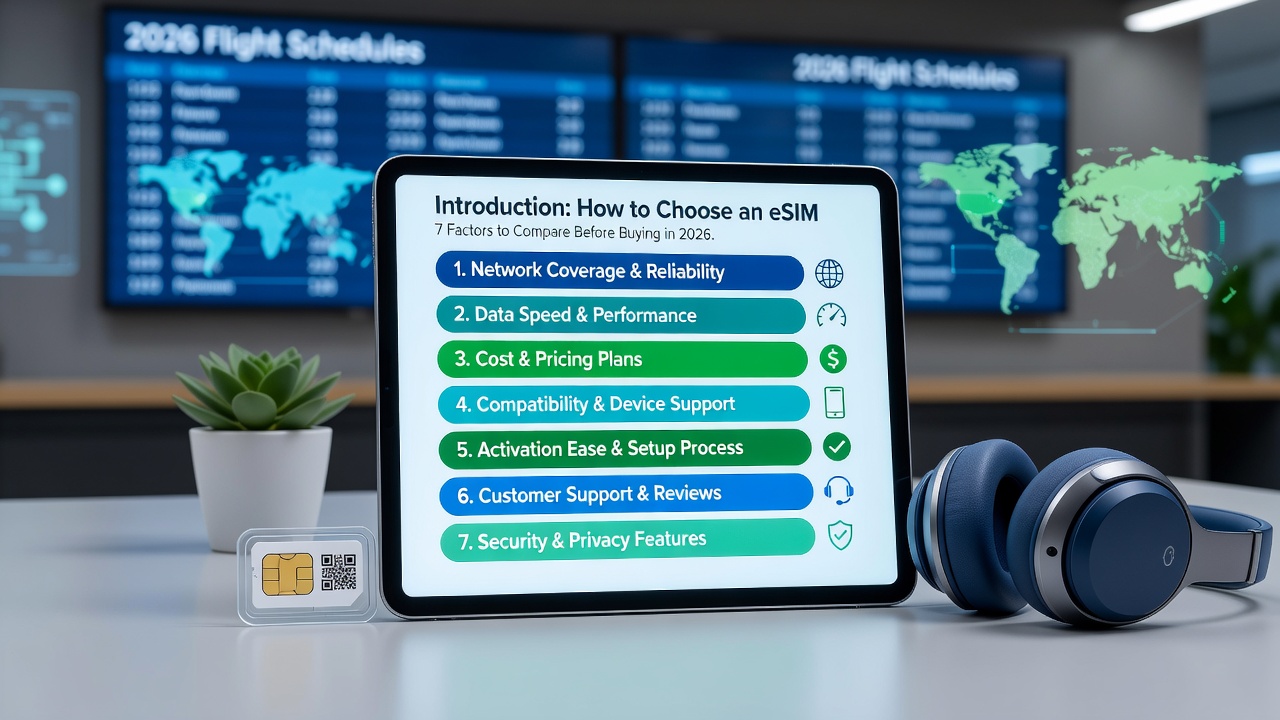
This guide cuts through the noise. We will walk through the seven factors that actually matter when comparing eSIM plans, with practical examples and real-world context for 2026. By the end, you will know exactly what questions to ask before tapping "buy."
1. Coverage: Where You Actually Get Signal
Coverage is the most important factor for most buyers—and the most misleading.
What "Coverage" Really Means
When an eSIM provider says they cover 150 countries, they usually mean they have roaming agreements in those countries. That is not the same as having reliable, high-speed coverage everywhere you plan to go.
Key questions to ask:
- Which local carriers does the eSIM partner with in each country? A partnership with AT&T in the US is very different from a partnership with a regional MVNO.
- Does coverage include rural and suburban areas, or just major cities?
- Is there 5G access, or is the plan limited to 4G/LTE?
- Are there any excluded regions within covered countries (e.g., remote islands, territories)?
Red Flags to Watch For
- Providers that list countries without naming partner networks.
- "Global" plans that rely heavily on a single roaming hub, creating latency issues.
- Maps that show coverage "by country" rather than by actual signal strength.
Pro tip for 2026: If you are traveling to regions with ongoing infrastructure upgrades (parts of Southeast Asia, sub-Saharan Africa, or rural Eastern Europe), verify that the eSIM provider has updated its partnerships within the last 12 months. Older agreements may still default to 3G in areas where 4G or 5G is now available.
2. Data Limits: Unlimited Rarely Means Unlimited
Data allowances are where marketing language diverges most sharply from reality.
Understanding the Types of Data Limits
| Type | What It Means | Best For |
|---|---|---|
| Fixed data (e.g., 5GB) | Exact amount; stops or charges overage when depleted | Short trips, light usage |
| "Unlimited" with throttle | Full speed up to a cap (e.g., 10GB), then reduced to 128–512 Kbps | Moderate usage, budget conscious |
| Truly unlimited | No throttle, no cap; rare and expensive | Heavy users, remote work |
| Daily fair-use | Unlimited but throttles after daily threshold (e.g., 2GB/day) | Social media, messaging, maps |
How Much Data Do You Actually Need?
Here is a realistic 2026 usage breakdown:
- Maps and navigation: ~100MB per hour
- Social media (photos/videos): ~150MB per hour
- Video calls (Zoom/Teams): ~500MB–1GB per hour
- Music streaming: ~100MB per hour
- Email and messaging: negligible
A two-week trip with moderate usage (maps, social media, some video calls) typically consumes 8–15GB. If you are working remotely, plan for 20–50GB minimum.
Red flag: Providers that advertise "unlimited" but bury the throttle threshold in fine print. In 2026, regulatory pressure in the EU and UK has forced more transparency, but global providers based elsewhere still play games with definitions.
3. Price: Total Cost vs. Per-GB Value
Price comparison is not as simple as finding the cheapest plan.
Calculating Real Value
To compare apples to apples, calculate the price per GB at full speed:
Price per GB = Total Plan Cost ÷ GB Available at Full Speed
Example:
- Plan A: $20 for "unlimited" (throttled after 5GB) → $4/GB at full speed
- Plan B: $25 for 10GB fixed → $2.50/GB
- Plan C: $35 for 20GB fixed → $1.75/GB
Plan C is often the better value unless you absolutely need the "unlimited" safety net.
Hidden Costs to Check
- Activation fees: Some providers charge $2–5 just to activate.
- Top-up rates: If you run out, how much does additional data cost?
- Multi-device fees: Can you use one plan across a phone and tablet?
- Currency conversion: Providers pricing in EUR or GBP may charge your card with fees.
2026 pricing context: The eSIM market has stabilized after aggressive 2023–2024 price wars. Expect to pay $1.50–$3.00 per GB for regional plans and $3.00–$6.00 per GB for true global coverage. Prices below $1/GB at full speed usually signal heavy throttling or poor network quality.
4. Speed and Throttling: Will It Actually Work?
Speed matters when you are trying to upload a video, join a video call, or simply load a map before a turn.
What Affects eSIM Speed?
- Network generation: 5G > LTE/4G > 3G. Not all "4G" is equal—LTE-Advanced can hit 100+ Mbps, while basic LTE might cap at 10 Mbps.
- Local congestion: If the partner network is overloaded, your speed drops regardless of what the eSIM provider promises.
- Roaming agreements: Some providers get deprioritized during congestion because they are not paying premium roaming rates.
Throttling Policies to Understand
Most "unlimited" plans throttle after a certain threshold. The difference between 128 Kbps (unusable for most things) and 5 Mbps (functional for messaging and maps) is enormous. Check the exact post-throttle speed before buying.
Realistic 2026 expectation: A quality eSIM on a good partner network should deliver 20–50 Mbps on LTE and 50–150 Mbps on 5G in major cities. Rural speeds vary but should still support basic browsing and navigation on 4G.
5. Activation: How Fast Can You Get Online?
One of eSIMs biggest selling points is instant activation. In practice, it ranges from "scan a QR code and go" to "contact support and wait 24 hours."
Activation Methods in 2026
- QR code: Scan, download profile, activate. Takes 2–5 minutes.
- In-app activation: Provider app pushes the profile directly. Often fastest.
- Manual entry: You enter SM-DP+ address and activation code. Prone to typos.
- Carrier approval required: Some countries (e.g., parts of the Middle East, China) require ID registration before activation.
What to Test Before Travel
If possible, install the eSIM profile before you leave home. Many providers let you install the profile while still on Wi-Fi, then activate the plan upon arrival. This eliminates airport stress and lets you troubleshoot on familiar Wi-Fi.
Red flags:
- Providers that require app downloads from regional app stores you cannot access.
- Activation processes that require SMS verification to a home number you cannot receive abroad.
- Customer support that is only available via email with 24+ hour response times.
6. Customer Support: Who Helps When It Breaks?
When your eSIM does not work in a foreign country at midnight, support quality becomes the only thing that matters.
Support Channels to Compare
| Channel | Response Time | Best For |
|---|---|---|
| Live chat | Minutes | Urgent issues |
| Minutes to hours | Non-urgent, async | |
| Hours to days | Complex issues | |
| Knowledge base | Instant | Self-service setup |
| Phone | Variable | Complicated account issues |
Evaluating Support Quality
Before buying, test the support:
- Ask a pre-sale question via chat. How fast do they respond? Is the answer accurate?
- Check if support is 24/7 or limited to business hours in a specific time zone.
- Look for reviews mentioning support specifically—Reddit, Trustpilot, and app store reviews are good sources.
2026 trend: AI chatbots now handle tier-1 support for most providers. This is fine for password resets and basic troubleshooting, but make sure there is a human escalation path for complex issues like activation failures or billing disputes.
7. Refund Policy and Flexibility
Even with perfect research, plans change. A flight gets delayed, a trip gets canceled, or the eSIM simply does not work in your specific device or location.
Refund Policies to Look For
- Unused data refunds: Can you get money back for data you did not use?
- Activation failure refunds: If the eSIM never works, is refund automatic?
- Change-of-mind refunds: Some providers offer 7–14 day refunds if the plan was never activated.
- Plan changes: Can you upgrade or switch regions without buying a new plan?
2026 Regulatory Landscape
Consumer protection for digital services has improved in the EU, UK, Australia, and several Asian markets. However, eSIM providers registered in other jurisdictions may offer minimal recourse. Check where the company is incorporated and whether they comply with GDPR, CCPA, or local equivalents.
Pro tip: Before a long trip, buy a short-duration plan (3–7 days) from your top two provider choices. Test them at your destination. Keep the one that works best. This "A/B test" approach costs more upfront but eliminates the risk of being stuck with a useless plan for weeks.
Key Takeaways
- Coverage quality beats coverage quantity. A provider covering 50 countries on fast networks beats one covering 150 on unreliable partners.
- "Unlimited" almost always has a throttle. Calculate price per GB at full speed to compare fairly.
- Speed and throttling policies matter more than marketing claims. Verify actual partner networks and post-throttle speeds.
- Activate before you travel. Install the eSIM profile on Wi-Fi to avoid airport stress.
- Test support responsiveness before buying. A 24-hour email delay is unacceptable when you are stranded.
- Check refund policies carefully. Unused-data refunds and activation-failure guarantees are essential safety nets.
- Consider an A/B test for long trips. Buy short plans from two providers and keep the winner.
Frequently Asked Questions
What is an eSIM and how is it different from a physical SIM?
An eSIM is an embedded SIM chip built into your device. Unlike a physical SIM card, you download carrier profiles digitally. This lets you switch carriers, add travel plans, or maintain multiple numbers without swapping plastic cards.
Do all phones support eSIM in 2026?
Most flagship smartphones released since 2020 support eSIM, including iPhone XS and newer, Samsung Galaxy S20 and newer, and Google Pixel 3 and newer. Many 2026 mid-range phones now include eSIM as well. Check your device specifications to confirm.
Can I use an eSIM and a physical SIM at the same time?
Yes. Most dual-SIM phones let you use a physical SIM for your home number and an eSIM for travel data. This lets you receive calls and texts on your regular number while using local data rates abroad.
Is eSIM cheaper than roaming with my home carrier?
Usually, yes. Home carrier roaming rates often cost $10–15 per day. A regional eSIM plan typically costs $2–5 per day for equivalent or better data allowances. For trips longer than a few days, eSIM savings are substantial.
What happens if I run out of data on my eSIM plan?
It depends on the provider. Some plans stop working entirely. Others throttle to very slow speeds. Many providers let you buy a top-up. Check the top-up cost and process before buying—some require app access you may not have abroad.
How do I know if an eSIM will work in my destination country?
Check the provider's coverage list for your specific destination, then verify which local networks they partner with. Look for recent user reviews from travelers in that country. Ideally, test a short-duration plan before committing to a longer one.
Can I get a refund if my eSIM does not work?
Most reputable providers offer refunds for activation failures or unused data, but policies vary. Some require you to contact support and troubleshoot first. Always read the refund policy before purchase, and buy from providers with clear, generous terms.
Does using an eSIM affect my phone's battery life?
Using an eSIM consumes marginally less battery than a physical SIM because there is no card reader to power. However, if your phone constantly searches for signal on a weak roaming network, battery drain increases. This is a network issue, not an eSIM issue.
Conclusion
Choosing the right eSIM in 2026 is not about finding the cheapest plan or the longest country list. It is about matching a provider's real-world performance to your specific needs. A remote worker streaming video calls needs different coverage and data than a tourist checking maps and posting photos.
Focus on the seven factors above, calculate true value rather than sticker price, and always have a backup plan. The best eSIM is the one you do not have to think about once you are on the ground—because it just works.
Ready to compare plans? Start by checking coverage for your specific destination and calculating your expected data usage. The right eSIM is out there; you just need to know what questions to ask.