Planning a trip to Aotearoa? Whether you're chasing glaciers on the South Island or soaking up geothermal wonders in Rotorua, staying connected matters. An international eSIM is the smartest way to get online in New Zealand without racking up roaming charges or wasting precious vacation time at airport kiosks.
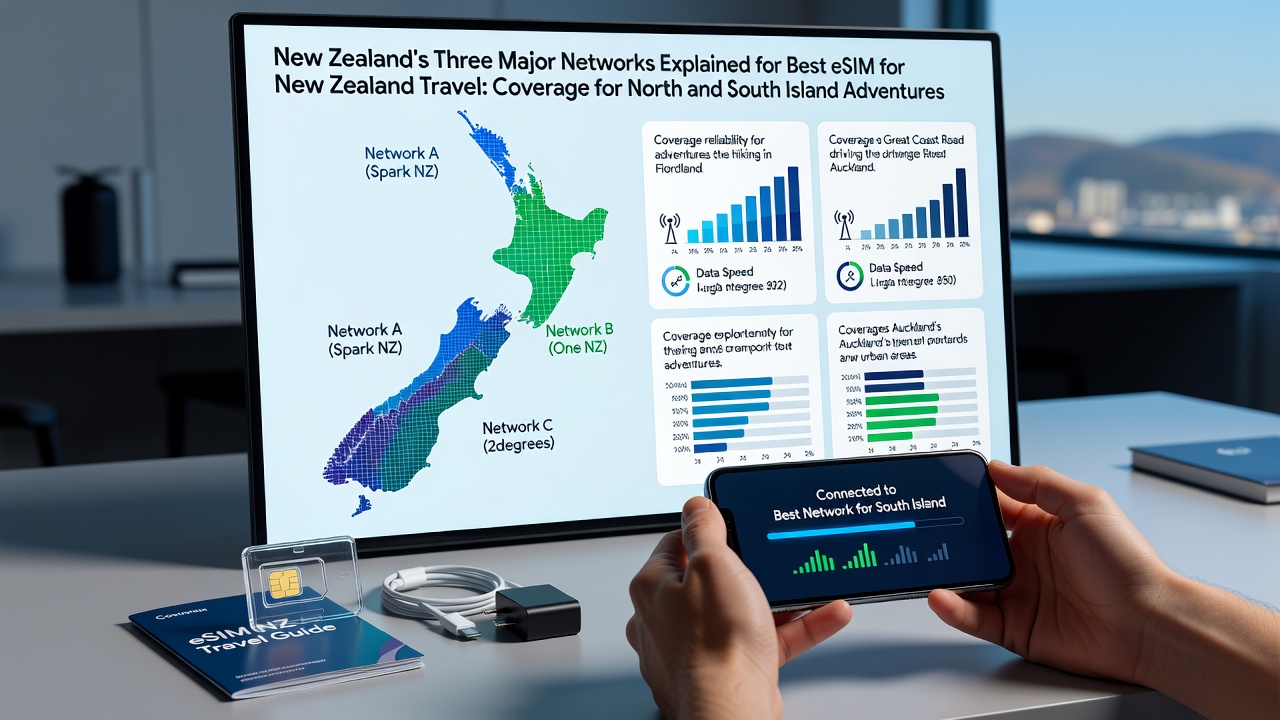
New Zealand's unique geography — two main islands, mountain ranges, and vast rural stretches — makes network coverage a real consideration. A SIM that works perfectly in Auckland might leave you stranded on the road to Milford Sound. This guide breaks down everything you need to know: the three major networks, tourist eSIM pricing, coverage in remote areas, and road trip connectivity tips for both islands.
New Zealand's Three Major Networks Explained
New Zealand has three primary mobile network operators, and every eSIM in the country runs on one of them. Understanding the differences before you buy an international eSIM can save you from frustrating dead zones.
Spark NZ — The Coverage Leader
Spark operates the most extensive mobile network in New Zealand, with the broadest 4G and 5G footprint across both islands. If your itinerary includes remote destinations — Fiordland, the West Coast, or the Coromandel Peninsula — Spark is generally your safest bet. Their network reaches more rural communities and tourist hotspots than any competitor.
Spark offers prepaid tourist eSIM plans through their website and retail stores. Typical tourist pricing:
- 1 GB for 7 days — NZ$9.99
- 3 GB for 30 days — NZ$29.99
- 5 GB for 30 days — NZ$44.99
You can activate a Spark eSIM before you fly via their app, which means you land connected. Spark also partners with several international eSIM platforms, so you may find Spark-backed plans through providers like Airalo or Holafly.
Vodafone NZ (One NZ) — Urban Strength and Speed
Vodafone New Zealand rebranded as One NZ in 2023, though many travellers still know it by its former name. The network excels in urban centres — Auckland, Wellington, Christchurch, Queenstown — with consistently fast 5G speeds and reliable capacity during peak tourist season.
Where One NZ falls slightly short is deep rural coverage. The South Island's West Coast and parts of Central Otago have more gaps on One NZ than on Spark. However, for city-hopping itineraries or business travel, One NZ delivers excellent performance.
Tourist eSIM pricing from One NZ:
- 2 GB for 30 days — NZ$20
- 5 GB for 30 days — NZ$40
- 10 GB for 30 days — NZ$60
One NZ eSIMs can be purchased online and activated instantly, making them convenient for last-minute planners.
2degrees — The Budget-Friendly Option
2degrees runs on a smaller network but roams onto Spark's towers in many areas, effectively giving you near-Spark coverage at a lower price point. This makes 2degrees an attractive option for budget-conscious travellers who still want decent rural reach.
2degrees tourist eSIM plans:
- 1 GB for 30 days — NZ$10
- 3 GB for 30 days — NZ$24
- 7 GB for 30 days — NZ$36
The trade-off is speed. In roaming areas, 2degrees may be throttled or limited to 3G/4G while Spark customers get full 4G or 5G. For maps, messaging, and browsing, that's fine. For streaming or video calls in remote areas, expect slower performance.
Coverage in Remote Tourist Areas: What to Expect
New Zealand's biggest attractions are often far from major towns. Here's how the networks perform in two of the most popular — and most isolated — destinations.
Milford Sound, South Island
Milford Sound is one of New Zealand's most iconic destinations, and also one of the most remote. The drive from Te Anau to Milford Sound covers nearly 120 km of mountainous Fiordland terrain with limited infrastructure.
Spark provides the most consistent coverage along the Milford Road, with 4G signal in Te Anau, at Knobs Flat, and patches along the Homer Tunnel approach. Inside the fiord itself, coverage is spotty on all networks.
One NZ has decent coverage in Te Anau but drops off quickly past the Eglinton Valley. Expect long stretches with no signal on the drive to Milford.
2degrees roams on Spark in this region, so you'll get similar coverage to Spark customers, though potentially at reduced speeds.
Tip: Download offline maps before leaving Te Anau. Regardless of which international eSIM you choose, you will have gaps on this route.
Tongariro Alpine Crossing, North Island
The Tongariro Alpine Crossing is often called the best day hike in New Zealand. It traverses active volcanic terrain between Mount Ngauruhoe and Mount Tongariro in the Central Plateau.
Spark has solid 4G coverage at the Mangatepopo trailhead and near the Ketetahi end of the track. Signal is intermittent along the ridge itself due to volcanic rock and elevation.
One NZ covers National Park Village and Whakapapa village well, with patchy signal on the crossing itself.
2degrees again roams on Spark, giving you coverage at the trailheads and the nearby towns of National Park and Turangi.
All three networks will keep you connected in the surrounding towns — Turangi, National Park Village, Ohakune — which is where most hikers stay. On the crossing itself, carry a personal locator beacon if hiking solo, as no network is fully reliable at elevation.
Road Trip Connectivity: North Island vs South Island
A classic New Zealand road trip involves both islands, and connectivity differs significantly between them. Here's what to plan for.
North Island Road Trips
The North Island is more densely populated, so coverage is generally better. Major routes — Auckland to Coromandel, Auckland to Rotorua, Wellington to Taupo — have near-continuous 4G on all three networks.
Gaps to watch for:
- The Coromandel Peninsula's east coast (Cathedral Bay area) — Spark has the edge
- Te Urewera and the East Cape — limited coverage on all networks
- The Forgotten World Highway (SH43) — virtually no signal on any network
If your North Island loop includes Cape Reinga at the top, Spark has the best coverage through Northland, while One NZ and 2degrees have notable gaps north of Kaitaia.
South Island Road Trips
The South Island is larger, more mountainous, and far less populated. Coverage gaps are longer and more frequent, especially on the West Coast and in Fiordland.
Key connectivity zones:
- Christchurch to Queenstown via SH1 and SH8 — generally good on all networks
- The West Coast (Greymouth to Haast) — Spark has the best coverage, One NZ has significant gaps
- The Canterbury highlands and Mackenzie Basin (Lake Tekapo, Aoraki/Mt Cook) — Spark and 2degrees perform well
- The drive to Milford Sound (SH94) — sparse on all networks, Spark has the most patches
Essential road trip tip: Download Google Maps or Maps.me offline regions for both islands before you start driving. Cell coverage in New Zealand's rural areas can disappear for 30–60 km stretches, and GPS navigation should never depend on a live data connection.
Choosing the Right International eSIM for New Zealand
When selecting an international eSIM for New Zealand travel, consider these factors:
- Network preference: If your itinerary is South Island-heavy or includes remote areas, choose a plan that runs on Spark's network. For city-focused trips, any network works.
- Data allowance: Tourist activities like navigation, photo uploads, and social media typically use 1–3 GB per week. Streaming video or hot-spotting can push that to 5–10 GB weekly.
- Activation convenience: Look for eSIMs you can activate before departure, so you land with working data.
- Multi-country plans: If you're visiting Australia or Pacific islands on the same trip, a regional eSIM might offer better value than a New Zealand-only plan.
Popular international eSIM platforms that offer New Zealand plans include Airalo, Holafly, Nomad, and Saily. Compare their pricing against buying directly from Spark, One NZ, or 2degrees — sometimes the local network offers better value, especially for longer stays.
FAQ: New Zealand eSIM Travel
Can I buy an eSIM at Auckland Airport?
Yes. Spark and One NZ both have retail counters at Auckland International Airport where you can purchase and activate a tourist eSIM on arrival. However, buying online before you fly is cheaper and saves time.
Does New Zealand have 5G for tourists?
Yes. Spark and One NZ both offer 5G in major cities and many regional centres. Tourist prepaid plans include 5G access where available. 2degrees also has growing 5G coverage in main urban areas.
Will my phone work in New Zealand?
New Zealand uses the same 4G LTE bands as most of Europe, Asia, and Australia (Band 1, 3, 7, 28). North American travellers should check Band 28 compatibility, as it's the primary rural coverage band. Most phones from 2022 onward support it.
Is Wi-Fi widely available in New Zealand?
Yes, but don't rely on it exclusively. Hotels, cafes, and visitor centres offer free Wi-Fi, but rural accommodations often have slow satellite connections. Having a mobile data eSIM as your primary connection is more reliable.
Final Thoughts
New Zealand rewards travellers who come prepared. The landscapes are jaw-dropping, the roads are well-maintained, and the people are welcoming — but the cell coverage in remote areas requires planning. Choosing an international eSIM backed by the right network for your itinerary ensures you can navigate, share, and stay safe throughout both islands.
For South Island adventures and remote destinations, Spark-backed eSIMs are the clear winner. For city-focused North Island trips, any network will serve you well. And for budget travellers who still want rural coverage, 2degrees offers a smart middle ground.
Wherever your New Zealand journey takes you — from the volcanic plateau of Tongariro to the deep waters of Milford Sound — the right eSIM keeps you connected to what matters: maps, memories, and the people back home.