Traveling to Switzerland and wondering about the best europe esim options for staying connected? Whether you are landing in Zurich, riding the Glacier Express through the Alps, or exploring the cobblestone streets of Lucerne, your phone is your map, your translator, and your camera roll — and a virtual SIM keeps it all online. Finding the best eSIM for Switzerland solves the connectivity question before you even step off the plane — no airport kiosk visits, no surprise roaming fees, no physical eSIM card swapping.
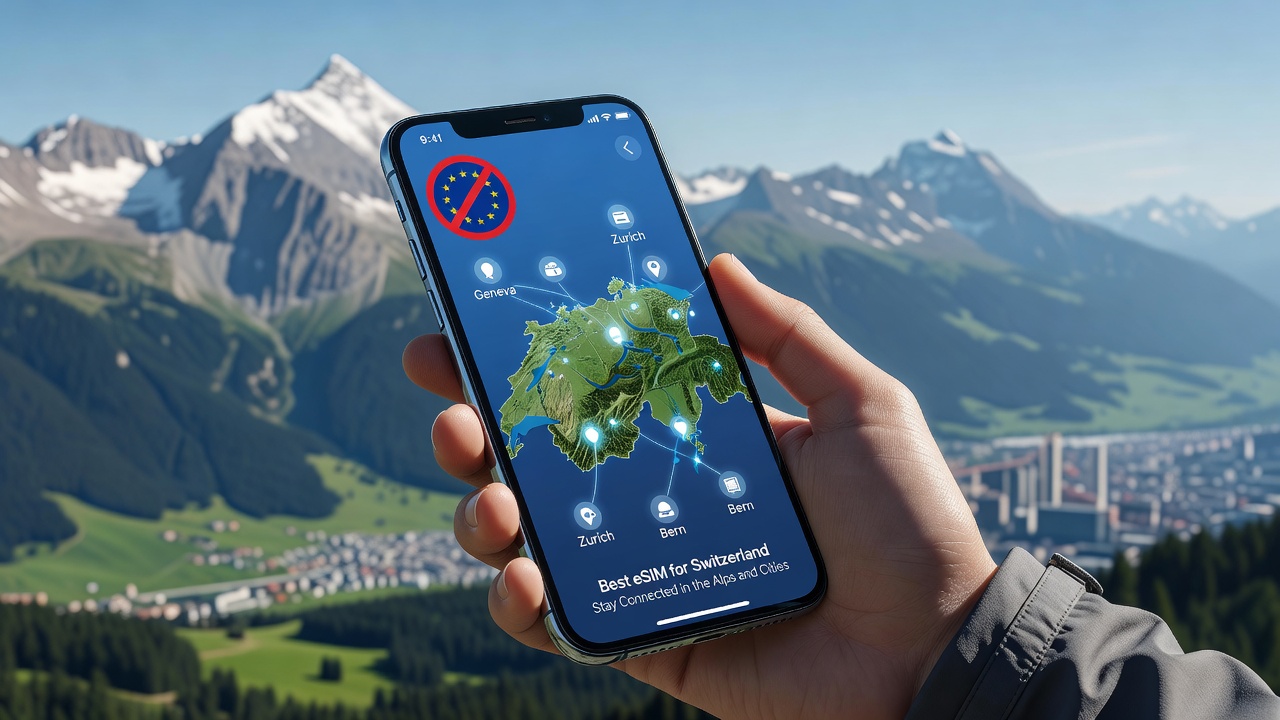
Switzerland is unique in the European connectivity landscape. It is not an EU member state, which means the EU's "Roam Like at Home" regulations do not apply. Your home carrier's EU roaming bundle likely excludes Switzerland entirely, and standard travel eSIM plans that advertise "Europe coverage" sometimes treat Switzerland as a surcharge zone. A good Switzerland travel eSIM solves this. This guide covers everything you need: the three major Swiss networks (Swisscom, Sunrise, and Salt), why EU roaming rules do not protect you here, tourist eSIM pricing with a comparison table, and practical tips for staying connected in Alpine regions where signal strength drops fast.
Why Switzerland Is Not Covered by EU Roaming
This is the single most common gotcha for travelers arriving in Switzerland. The European Union's "Roam Like at Home" regulation, which allows EU/EEA residents to use their domestic data allowance while roaming across 30+ European countries at no extra cost, does not extend to Switzerland. The reason is straightforward: Switzerland is not a member of the EU or the EEA. It is part of the Schengen Area for border-free travel, but Schengen is about movement of people, not telecom regulations.
In practice, this means:
- EU carrier plans exclude Switzerland from roaming bundles. If you have a German, French, or Italian mobile plan with EU roaming included, your phone will connect to a Swiss network, but you will be hit with data roaming surcharge rates — often €0.20–€0.60 per MB.
- Travel eSIM "Europe" plans may or may not include Switzerland. Some providers treat Switzerland as part of their Europe regional package; others exclude it or charge a premium. Always check the country list before purchasing.
- Swiss carriers offer their own roaming add-ons for outbound travelers, but these are designed for Swiss residents traveling abroad, not for tourists coming to Switzerland.
The bottom line: if you are flying into Switzerland with a standard European SIM card expecting free roaming, you will get an unpleasant surprise on your next bill. A dedicated international eSIM with confirmed Switzerland coverage is the safe, predictable solution.

Switzerland's Mobile Networks: Swisscom, Sunrise, and Salt
Switzerland has three major mobile network operators. Understanding the differences helps you choose an eSIM provider that connects to the right network for your itinerary.
Swisscom
Swisscom is the incumbent operator and has the broadest coverage in Switzerland, including the most extensive Alpine and rural network. It operates on 2G (GSM 900/1800), 3G (UMTS 2100), 4G/LTE (bands 3, 7, 20, 28, 32), and 5G (n28, n78). Swisscom claims over 99% population coverage and has invested heavily in extending coverage to mountain regions, railway lines, and ski resorts. If your eSIM connects to Swisscom, you will have the best chance of signal in remote Alpine areas like Zermatt, St. Moritz, and the Jungfrau region.
Sunrise
Sunrise is the second-largest operator, with strong urban coverage and competitive pricing. It uses 4G/LTE bands 1, 3, 7, 20, and 28, with 5G on n78. Sunrise covers over 98% of the population and has been expanding its Alpine coverage, though it still trails Swisscom in the most remote mountain valleys. Sunrise is a solid choice for city-based trips (Zurich, Geneva, Basel, Bern) and major tourist routes.
Salt
Salt (formerly Orange Switzerland) is the third operator, with competitive pricing and good urban coverage but the smallest network footprint of the three. Salt operates 4G/LTE on bands 1, 3, 7, and 20, with 5G rolling out in major cities. Coverage in cities and major transit corridors is excellent, but expect gaps in remote Alpine regions. If your eSIM partner uses Salt, you should be fine for city trips but may lose signal in the high mountains.
eSIM Plans for Switzerland: Pricing Comparison (2026)
Here is a comparison of prepaid eSIM providers offering Switzerland coverage in 2026. All plans are data only (no voice or SMS included). Prices are approximate and may vary — always check the provider's website for current pricing.
| Provider | Starting Price (USD) | Data Options | Swiss Network | Validity | Best For |
|---|---|---|---|---|---|
| iWanteSIM | $1.00 | 1 GB – 50 GB + Unlimited Day Pass | Swisscom, Sunrise | 1–180 days | Best value, Alpine coverage via Swisscom |
| Airalo | $4.50 | 1 GB – 20 GB | Swisscom, Sunrise | 7–30 days | Frequent flyers, eSIM app-based management |
| Holafly | $19.00+ | Unlimited data | Swisscom | 1–90 days | Heavy data users, remote work |
| aloSIM | $4.00 | 1 GB – 10 GB | Sunrise, Salt | 7–30 days | Budget city trips |
| Nomad | $5.00 | 1 GB – 20 GB | Swisscom partner | 7–30 days | Mid-budget travelers |
Winner for value: iWanteSIM at $1.00. If you are looking for a cheap eSIM option, no other major provider offers a sub-$2 entry plan for Switzerland. The iWanteSIM 1 GB / 7-day plan covers Switzerland on Swisscom and Sunrise networks, giving you access to the two strongest networks for Alpine and city coverage alike. For longer trips, the 10 GB / 30-day plan at $8.00 offers excellent value for a two-week Switzerland itinerary with heavy Google Maps usage, photo uploads, and streaming.
Winner for heavy data: Holafly. If you plan to hotspot, stream, or upload large video files daily, Holafly's unlimited plans eliminate data anxiety. The trade-off is price — starting at $19/day for unlimited, it is significantly more expensive than fixed-data alternatives.
Staying Connected in the Swiss Alps: Mountain Connectivity Realities
Switzerland's Alpine landscape is both its biggest attraction and its biggest connectivity challenge. Mountain valleys, tunnels, and remote hiking trails create natural dead zones where no network reaches. Here is what to expect and how to prepare.
Where You Will Have Signal
- Major cities (Zurich, Geneva, Basel, Bern, Lausanne): Full 4G/5G on all three networks. No connectivity concerns.
- Major railway lines (Glacier Express, Bernina Express, GoldenPass): Swisscom has invested in along-track coverage for key tourist railways. Expect intermittent 4G with gaps in tunnels and deep valleys. Sunrise covers most of the route; Salt has more gaps.
- Ski resorts (Zermatt, Verbier, St. Moritz, Davos): Swisscom provides coverage at most major resorts and base stations. Coverage thins out on higher slopes and back-country areas.
- Lake regions (Lake Lucerne, Lake Geneva, Lake Thun): Generally good coverage on all networks, especially on populated shorelines.
Where You Will Lose Signal
- Deep valleys and gorges: Physical terrain blocks signal. Lauterbrunnen Valley, the Rhine Gorge, and remote sections of the Engadin Valley have limited or no coverage.
- Inside tunnels: Switzerland has thousands of railway and road tunnels, including the Gotthard Base Tunnel (57 km). Signal is typically lost inside all tunnels except the busiest urban ones.
- High-altitude hiking trails: Above 2,500m, on trails away from ski infrastructure, do not count on a data connection. Download offline maps before you go.
- Mountain huts and refuges: SAC (Swiss Alpine Club) huts are increasingly getting Wi-Fi, but cellular data is often unavailable.
Practical Tips for Alpine Connectivity
- Download offline maps. Google Maps, Maps.me, and Swisstopo all support offline downloads. Do this before leaving your hotel Wi-Fi.
- Choose Swisscom-connected eSIMs for mountain trips. If your itinerary includes Zermatt, the Jungfrau region, or remote Alpine villages, prioritize an eSIM that connects to Swisscom. It has the best rural and mountain coverage by a significant margin.
- Carry a power bank. Cold mountain temperatures drain phone batteries fast, and searching for signal in weak-coverage areas accelerates battery drain. A 10,000 mAh power bank is a good minimum for full-day Alpine excursions.
- Use Wi-Fi at hotels and cafes. Swiss hotels generally offer free Wi-Fi, and most cafes in tourist towns provide it too. Use Wi-Fi for heavy uploads and software updates to conserve your travel data.
- Switch to 3G in weak 4G areas. Sometimes a 3G signal reaches where 4G cannot. Toggling your phone to 3G-only mode in remote areas can give you a usable (if slow) connection for messaging and basic browsing.
How to Choose the Right eSIM for Your Switzerland Trip
The right eSIM depends on your itinerary and data habits. Here is a quick decision framework:
- City-only trip (Zurich, Geneva, Basel, Bern), 3–5 days: Any provider works. Choose iWanteSIM 3 GB for $3.50 — sufficient data plan for maps, messaging, and light browsing.
- Alpine adventure (Zermatt, Jungfrau, Engadin), 5–10 days: Prioritize Swisscom coverage. iWanteSIM 10 GB for $8.00 on Swisscom gives you the best combination of mountain coverage and data allowance.
- Multi-country European trip including Switzerland: Check that your Europe eSIM explicitly lists Switzerland. iWanteSIM's Europe regional eSIM covers Switzerland along with 30+ other countries — or choose a global eSIM if your trip spans continents. Avoid providers that list Switzerland as a surcharge destination.
- Remote work / heavy data user: Holafly unlimited on Swisscom gives you peace of mind for video calls and large file uploads, at a higher price point.
Frequently Asked Questions
Does EU roaming work in Switzerland?
No. Switzerland is not an EU or EEA member, so the EU's "Roam Like at Home" regulation does not apply. If you have a European mobile plan with included EU roaming, your phone will connect to Swiss networks, but you will be charged out-of-bundle surcharge rates — often €0.20–€0.60 per MB. A dedicated travel eSIM with confirmed Switzerland coverage is the way to avoid these charges.
Which Swiss network has the best coverage in the Alps?
Swisscom has the broadest Alpine coverage by a significant margin, including coverage at major ski resorts, along key tourist railway lines, and in many remote villages. If your itinerary includes mountain regions, choose an eSIM that connects to Swisscom. Sunrise is a solid second choice for urban and major tourist routes. Salt has the smallest footprint and may have gaps in remote areas.
Can I buy a Swiss eSIM at the airport?
You can purchase eSIMs from Swisscom, Sunrise, and Salt at Zurich and Geneva airports, but airport prices are typically higher than online travel eSIM providers. For better value, buy an eSIM online before your trip — iWanteSIM plans start at $1.00 and are delivered instantly via email with a QR code for eSIM activation.
Will my eSIM work on Swiss mountain railways like the Glacier Express?
Yes, but expect intermittent coverage. Swisscom has invested in along-track coverage for major tourist railways, so you will get signal on most of the route, with gaps in tunnels and deep valleys. Download offline entertainment and maps before boarding. Shorter tunnels may have signal restoration within seconds; longer tunnels (like the Gotthard) will have no signal throughout.
Conclusion: Stay Connected in Switzerland Without the Surprises
Switzerland is a dream destination — snow-capped peaks, pristine lakes, world-class public transport — but its telecom landscape catches many travelers off guard. The EU roaming exemption means your European SIM will not work for free here, and the Alpine terrain creates connectivity challenges that city-focused travelers never face.
The solution is simple: buy a Switzerland-compatible travel eSIM before you fly. Look for a provider that connects to Swisscom for the best mountain coverage, check that Switzerland is explicitly listed in the coverage area (not all "Europe" plans include it), and download offline maps for your Alpine excursions. With a $1.00 iWanteSIM plan or a $8.00 / 10 GB plan for longer trips, you get reliable data on Switzerland's best networks without the roaming bill shock that ruins an otherwise perfect vacation.
Switzerland does not have to be a mobile data gamble. With the right eSIM, your phone stays useful from Zurich Airport to the top of the Jungfraujoch — and everywhere in between.