
Finding the best eSIM for Vietnam travel can make or break your trip — especially when navigating Hanoi's Old Quarter one day and trekking Sapa's rice terraces the next. Vietnam's mobile landscape is dominated by three major operators — Viettel, Mobifone, and Vinaphone — and knowing which eSIM providers use which networks is the key to staying connected from the northern highlands to the Mekong Delta.

In this guide, we break down everything about choosing an asia esim for Vietnam: real tourist pricing, network-by-network coverage comparisons, data speed expectations, and practical advice for staying online whether you're in a Ho Chi Minh City café or on a junk boat in Ha Long Bay.
Vietnam's Mobile Networks: Viettel, Mobifone, and Vinaphone
Before picking an eSIM, it helps to understand the three carriers that power them. Most tourist eSIMs for Vietnam connect to one or more of these networks.
Viettel — The Coverage King
Viettel is Vietnam's largest mobile operator with the most extensive network infrastructure. It offers 5G in major cities including Hanoi, Ho Chi Minh City, Da Nang, and Hai Phong, with 4G/LTE covering over 95% of the population. Viettel is the go-to network for rural and remote areas — if you're heading to Sapa, Ha Giang, or the Central Highlands, an eSIM that uses Viettel will give you the best chance of staying connected. Data speeds on Viettel's 4G network typically range from 20-50 Mbps in cities and 5-15 Mbps in rural zones.
Mobifone — Strong Urban Performer
Mobifone is Vietnam's second-largest carrier, known for reliable service in urban and suburban areas. It offers 5G in central districts of Hanoi and Ho Chi Minh City, with solid 4G coverage across most populated regions. Speeds are comparable to Viettel in cities (15-45 Mbps on 4G), but coverage can get patchy in remote areas like the mountain passes around Sapa or the less-touristed parts of Ha Long Bay. For city-focused trips, Mobifone is a strong choice.
Vinaphone (VNPT) — The Balanced Option
Vinaphone, operated by state-owned VNPT, is the third major player. It provides good 4G coverage in all major cities and most provincial towns, with 5G rolling out in central Hanoi and HCMC. Vinaphone's rural coverage has improved significantly — it now reaches most tourist destinations including Sapa town and Ha Long Bay's main harbor areas. Expect 4G speeds of 15-40 Mbps in cities and 5-12 Mbps in rural areas. Many budget-friendly eSIM providers use Vinaphone's network.
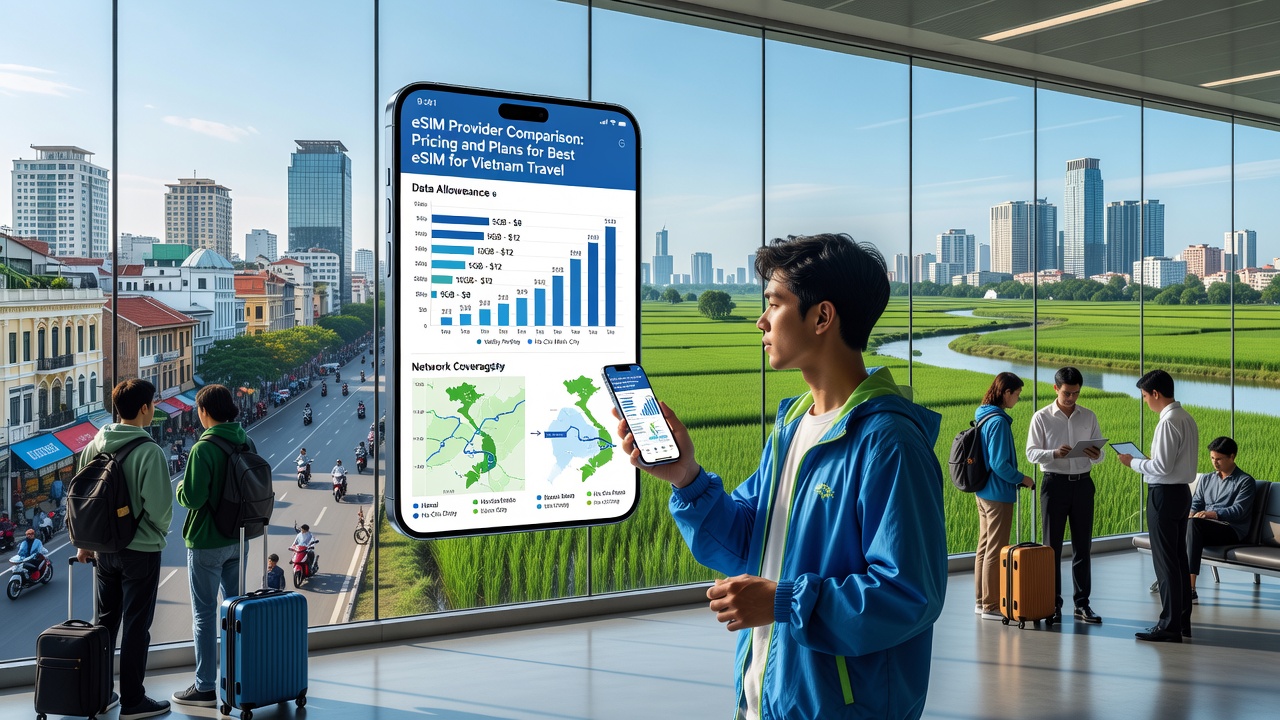
eSIM Provider Comparison: Pricing and Plans
Here's how the major eSIM providers stack up for Vietnam travel, with actual pricing as of August 2026:
| Provider | Network | Data | Validity | Price (USD) | Best For |
|---|---|---|---|---|---|
| Airalo (Xin Chao) | VNPT/Vinaphone | 1 GB | 7 days | $4.00 | Light users, short trips |
| Airalo (Xin Chao) | VNPT/Vinaphone | 3 GB | 30 days | $8.00 | Moderate use, longer stays |
| Airalo (Xin Chao) | VNPT/Vinaphone | 10 GB | 30 days | $18.00 | Heavy data users |
| Airalo (Xin Chao) | VNPT/Vinaphone | Unlimited* | 10 days | $34.50 | Streaming, video calls |
| Holafly | Viettel + others | Unlimited | 3 days | $11.90 | Weekend trips |
| Holafly | Viettel + others | Unlimited | 7 days | $27.50 | One-week holidays |
| Holafly | Viettel + others | Unlimited | 15 days | $50.50 | Two-week itineraries |
| Holafly | Viettel + others | Unlimited | 30 days | $73.90 | Long-term travel |
| eSIMX | Multiple | 50 GB | 10 days | $7.99 | Budget, high data |
| ChillaxSIM | Multiple (5G) | 50 GB | 10 days | $12.88 | Speed + value |
| GIGAGO | Multiple (5G) | 5 GB/day | 10 days | $17.68 | Daily heavy use |
| Ubigi | Multiple (5G) | 10 GB | 7 days | $7.80 | Short trips, good value |
*Airalo Unlimited: fair usage policy of 1 Mbps after 3 GB per day. Holafly Unlimited: fair usage policy applies after high daily usage; speeds may be reduced during peak hours.
City vs Rural Connectivity: What to Expect
Hanoi and Ho Chi Minh City — Full Speed Ahead
In Vietnam's two largest cities, you'll enjoy the best connectivity the country has to offer. Both Hanoi and Ho Chi Minh City have dense 4G and growing 5G coverage from all three major networks. In central districts like Hoan Kiem (Hanoi) and District 1 (HCMC), expect consistent 4G speeds of 25-50 Mbps — fast enough for video calls, Google Maps navigation, and uploading your pho photos to Instagram. Cafés, hotels, and most restaurants also offer free WiFi, so you can save your eSIM data for when you're out exploring.
Sapa — Prepare for Patchy Coverage
Sapa's mountainous terrain presents real connectivity challenges. In Sapa town itself, all three networks provide usable 4G (5-15 Mbps), with Viettel performing best. However, once you start trekking to villages like Cat Cat, Ta Van, or Lao Chai, coverage becomes highly variable. Viettel is the only network that maintains a signal on most trekking routes — if your eSIM uses Mobifone or Vinaphone only, expect dead zones once you're 2-3 km outside town. Download offline Google Maps of the Sapa region before heading out.
Ha Long Bay — Signal on the Water
Ha Long Bay presents a unique connectivity scenario. At the harbor and on the mainland (Ha Long City), all networks deliver strong 4G. Once you're out on the water, coverage depends on your distance from shore and which islands you're near. Viettel again leads here — most cruise routes through the bay maintain at least a weak 4G signal. Mobifone and Vinaphone can drop out in the more remote sections of the bay. If you're doing an overnight cruise, expect your connection to come and go — perfect excuse to put the phone down and enjoy the limestone karsts.
How to Choose the Right eSIM for Your Vietnam Trip
- City-only trip (Hanoi + HCMC): Any provider works well. Go for value — Airalo's 3 GB/30 days at $8 or Ubigi's 10 GB/7 days at $7.80 are excellent choices. All three networks perform well in urban Vietnam.
- Northern loop (Hanoi → Sapa → Ha Giang): Prioritize Viettel network access. Holafly connects to Viettel and offers unlimited data, making it the safest bet for rural coverage. eSIMX and ChillaxSIM also connect to multiple networks including Viettel.
- Coastal route (HCMC → Hoi An → Ha Long Bay): A balanced approach works. Airalo's VNPT-based plans cover most coastal towns well. For Ha Long Bay specifically, a multi-network eSIM like Holafly or GIGAGO gives you backup options if one network drops.
- Budget backpacker: eSIMX at $7.99 for 50 GB over 10 days is unbeatable value. You can buy two for a longer trip and still spend under $16.
Practical Tips for eSIM Purchase and Activation
- Buy before you fly. Purchase and install your eSIM before leaving home. You'll need a stable internet connection for installation. The eSIM activates when you connect to a Vietnamese network upon arrival — not before.
- Check device compatibility. Most iPhones from XS/XR onward, Google Pixels from 3 onward, and recent Samsung Galaxy devices support eSIM. Check your settings under Cellular/Mobile for an "Add eSIM" option.
- Keep your home SIM active for calls. Most tourist eSIMs are data-only. Keep your primary SIM enabled for receiving SMS (two-factor authentication) and emergency calls — just disable data roaming on it to avoid charges.
- Download offline maps. Before heading to Sapa, Ha Long Bay, or any rural area, download offline Google Maps for the region. Even with the best eSIM, coverage can drop in remote spots.
- Enable data roaming on your eSIM. This sounds counterintuitive, but most travel eSIMs require data roaming to be turned ON for the eSIM line. Check your provider's instructions.
- Top up if needed. Many providers like Airalo let you top up your eSIM through their app if you run low on data. No need to buy a whole new plan.
Frequently Asked Questions
Do I need to register my eSIM with Vietnamese authorities?
No. Tourist eSIMs purchased from international providers like Airalo, Holafly, or eSIMX are pre-registered and do not require additional documentation. You simply install and activate — no passport registration needed, unlike buying a local physical SIM in Vietnam.
Which network is best for rural Vietnam?
Viettel is the clear winner for rural coverage in Vietnam. It has the most extensive tower network and reaches areas that Mobifone and Vinaphone don't. If your trip includes Sapa, Ha Giang, or the Mekong Delta's more remote areas, choose an eSIM provider that connects to Viettel's network.
Can I use one eSIM for multiple Southeast Asian countries?
Yes. If Vietnam is part of a larger Southeast Asia trip, consider a regional asia esim plan. Providers like Airalo offer Asia regional eSIMs covering 10+ countries, and Holafly has multi-country plans. These cost more than single-country eSIMs but save you the hassle of switching plans at each border. A regional Asia eSIM typically runs $15-50 depending on data and duration.
Staying connected in Vietnam doesn't have to be complicated or expensive. With eSIM plans starting at just $4 and unlimited data options under $12 for short trips, you can navigate Hanoi's maze of motorbikes, share your Ha Long Bay sunrise in real time, and still have data left to book your next bus to Hoi An — all without visiting a SIM card shop.