
Introduction
Thailand is one of Southeast Asia's most popular travel destinations, drawing millions of visitors each year to its golden temples, tropical islands, bustling street markets, and world-famous cuisine. But the best time to visit Thailand depends entirely on what kind of trip you want—whether that means lounging on sun-drenched beaches, trekping through misty northern mountains, or splashing through the joyous Songkran water festival. Thailand's tropical climate is governed by two monsoon seasons and three distinct periods: the cool dry season, the hot season, and the rainy monsoon season. Understanding Thailand's weather patterns by month is essential for planning a trip that matches your ideal travel conditions.
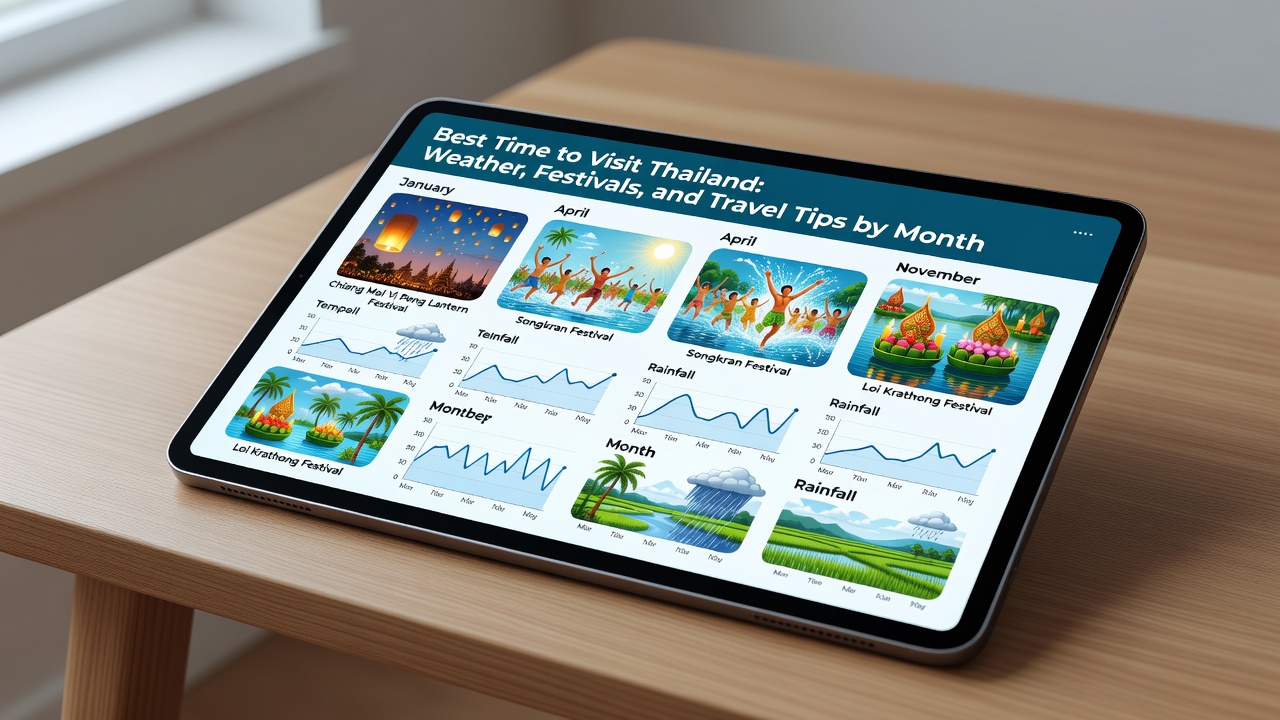
This comprehensive month-by-month guide to the best time to visit Thailand covers everything from peak season pricing and off-peak bargains to the country's most celebrated festivals. We'll also share practical travel tips—including how to get a Thailand eSIM for instant connectivity so you can navigate, book, and share your journey from the moment you land.
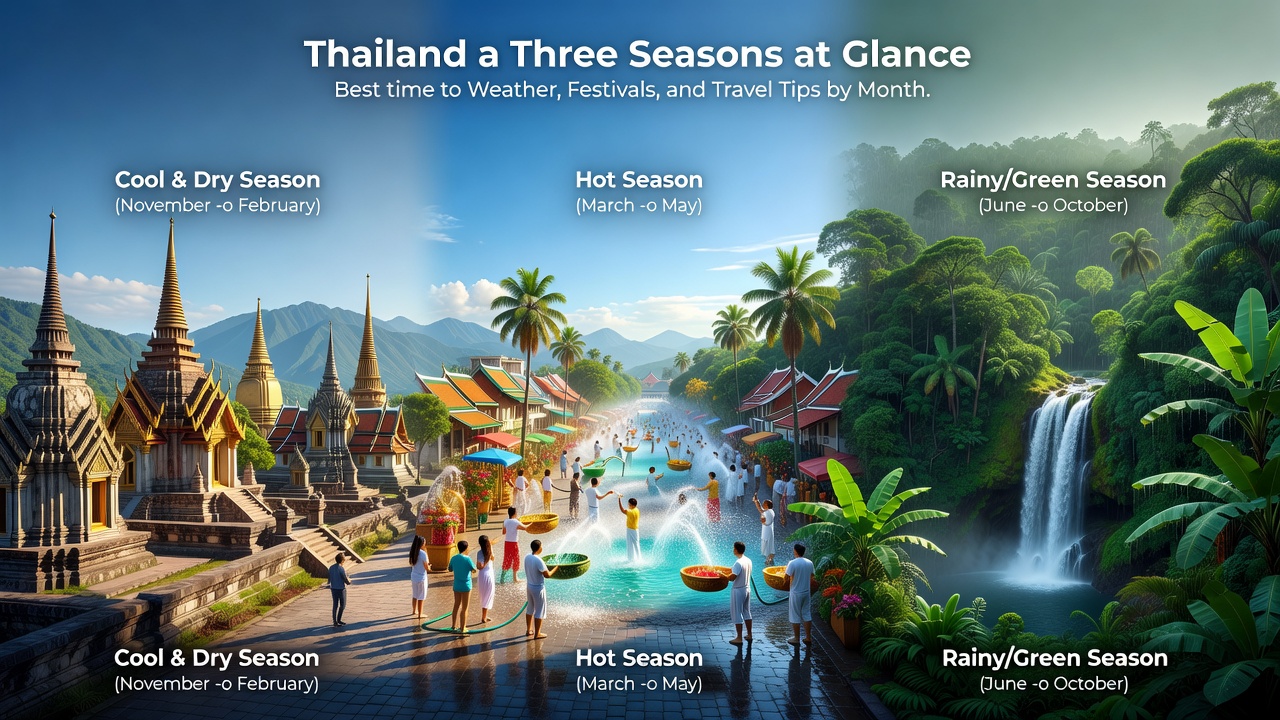
Thailand's Three Seasons at a Glance
Thailand's climate is tropical, but it varies significantly between the northern and southern regions. In general, the country experiences three seasons:
- Cool / Dry Season (November–February): The most popular time to visit. Pleasant temperatures, low humidity, and blue skies—especially in northern and central Thailand.
- Hot Season (March–May): Scorching temperatures across most of the country. This includes Songkran (Thai New Year) in mid-April, which brings nationwide water fights.
- Rainy / Monsoon Season (May–October): The southwest monsoon brings heavy but often brief downpours. Southern Thailand's two coasts have different rain patterns during this period.
Understanding which season fits your travel style is the first step in deciding the best time to visit Thailand.
Month-by-Month Weather & Travel Guide
November — Shoulder Season Perfection
Weather: November marks the official start of the cool dry season. Temperatures in Bangkok average 29°C (84°F), and Chiang Mai sees pleasant highs around 28°C (82°F). The northeast monsoon brings mild, dry air across most of the country.
Highlights: The end of the rainy season means lush green landscapes and full waterfalls in northern and northeastern Thailand. Daytime conditions are perfect for trekking around Chiang Mai, Pai, and the national parks. The full moon of November brings Loi Krathong (also known as Yi Peng in the north), when thousands of lanterns float into the night sky and krathong rafts drift on rivers nationwide—one of Thailand's most beautiful festivals.
Travel Tips: November is the start of the shoulder season. Prices are still reasonable compared to December–January, but book ahead for popular destinations. Northern Thailand offers the best trekking conditions of the year. Download a Thailand eSIM before you go so you can use maps and translation apps on arrival.
December — Peak Season at Its Finest
Weather: Clear skies, low humidity, and daytime highs of 31°C (88°F) in Bangkok. Northern areas like Chiang Mai drop to a refreshing 13–15°C (55–59°F) at night—Thais break out the sweaters and puffer jackets.
Highlights: This is Thailand at its most beautiful. Phuket, Krabi, Koh Samui, and Koh Phi Phi are at their sunny peak with calm seas and perfect beach weather. The northern mountains offer spectacular sunrise views over seas of fog. Cherry blossoms (Himalayan cherry) bloom at Phu Lom Lo in the northeast.
Travel Tips: December is Thailand's high season. Hotel and flight prices are at their peak, and beaches are packed with sun-seekers. Book accommodations 2–3 months in advance. Bring a light jacket for northern evenings. The cool weather makes December the best time to visit Thailand for travelers who want outdoor activities without heat exhaustion.
January — Cool and Celebratory
Weather: Similar to December: cool mornings, warm afternoons, and virtually no rain across most of the country. Bangkok averages 26–32°C (79–90°F). Southern islands enjoy their best weather of the year.
Highlights: New Year's Eve celebrations in Bangkok, Chiang Mai, and Phuket are world-class. Great month for island hopping in the Andaman Sea (Phuket, Krabi, Koh Lanta). Snorkeling and diving visibility is at its best. Chinese New Year (late January or early February) brings vibrant celebrations in Bangkok's Yaowarat district and Phuket Old Town.
Travel Tips: This is the busiest and most expensive month—book everything well in advance. For budget-conscious travelers, January is not the best time to visit Thailand for value. Consider visiting the less-crowded Gulf islands like Koh Tao or Koh Phangan instead of the Andaman hotspots. Stay connected with a Thailand travel eSIM to share real-time updates and navigate unfamiliar streets.
February — Dry Season Sweet Spot
Weather: Last month of the cool dry season. Temperatures begin to rise but remain pleasant. Average highs of 33°C (91°F) in Bangkok. Minimal rainfall nationwide.
Highlights: February offers the same fantastic weather as December–January but with thinner crowds. Beach destinations are still lovely. The blooming season in northern Thailand is in full swing—wildflowers blanket Doi Suthep and Phu Tabberk. Chinese New Year usually falls in late January or February, with colorful parades and lion dances in cities nationwide.
Travel Tips: This is one of the best times to visit Thailand for a balanced experience—great weather without peak-season crowds and prices. Excellent time for a northern Thailand road trip or a combined Bangkok/beach itinerary. February remains high season for many resorts, but last-minute availability is better.
March — Hot Season Begins
Weather: The hot season arrives. Temperatures soar to 35–36°C (95–97°F) in northern cities like Chiang Mai. Bangkok hits 34°C (93°F) with rising humidity. The sea remains calm in the Gulf of Thailand, though the Andaman coast starts seeing occasional rain.
Highlights: Fewer tourists means lower prices and emptier temples. This is mango season—Thailand's most beloved fruit hits its peak, along with mangosteens and rambutans. The beaches of Koh Samui, Koh Phangan, and Koh Tao enjoy their best weather window (they sit in the Gulf, which stays drier than the Andaman side during March–April).
Travel Tips: March is a good compromise month. Prices drop from February highs while weather is still mostly dry. If you can handle heat, you'll find great deals. Plan outdoor activities for early morning or late afternoon. Stay hydrated and use SPF 50+ sunscreen liberally. An eSIM for Thailand lets you check weather forecasts on the go.
April — Songkran Water Festival & Scorching Heat
Weather: The hottest month of the year. Daytime highs can reach 37°C (99°F) in the north and 35°C (95°F) in central Thailand. Humidity climbs noticeably. Southern Thailand remains warm, with the Gulf side still relatively dry.
Highlights: The undisputed star of April is Songkran, the Thai New Year festival (officially April 13–16). Recognized by UNESCO as an Intangible Cultural Heritage, Songkran transforms the entire country into a joyful water fight. The traditions go far beyond water guns: families pour perfumed water over Buddha statues for cleansing, pay respects to elders with a ritual called Rod Nam Dum Hua, build sand stupas at temples, and receive blessings. Chiang Mai is legendary for its week-long Songkran celebrations around the ancient city moat. Bangkok's Khao San Road and Silom Road become epic water-fight zones with live music and street parties. This is also when Bangkok empties out, making commutes and sightseeing unexpectedly pleasant in between water battles.
Travel Tips: April is not the best time to visit Thailand for heat-sensitive travelers, but it's the absolute best time for cultural immersion. Book accommodations far in advance for Songkran (April 13–16). Prepare for water: protect electronics in waterproof pouches (your phone with an eSIM is less vulnerable than a physical SIM card—no tray to open for water damage). Expect road closures and heightened traffic during Songkran. The Seven Dangerous Days (April 11–17) see increased road accidents, so drive with extreme caution.
May — Monsoon Arrives
Weather: The southwest monsoon season starts in mid-May. Rain begins in earnest, especially in the Andaman coast (Phuket, Krabi, Koh Lanta). However, May showers are typically brief—20–30 minute tropical downpours in the late afternoon rather than all-day rain. Temperatures remain high at 33–35°C (91–95°F). The Gulf of Thailand stays relatively drier.
Highlights: Low season rates kick in across most of the country. Five-star resorts on the Andaman coast drop to a fraction of their high-season prices. Fewer tourists mean quieter temples, less-crowded markets, and more personalized service. The countryside is at its greenest—absolutely stunning for photography.
Travel Tips: May is the best time to visit Thailand for budget travelers. Check weather forecasts for the specific region—the Gulf islands (Samui, Phangan, Tao) are still a viable choice. Pack a light rain jacket and waterproof sandals. Afternoon rain is predictable—plan morning-heavy itineraries and indoor afternoon activities. An international eSIM keeps you online even if inclement weather disrupts local SIM shops.
June — Green Season Bargains
Weather: Full monsoon conditions for most of the country. Andaman coast sees regular rain. Central Thailand (Bangkok, Ayutthaya) experiences humid conditions with heavy but short-lived afternoon showers. Northern Thailand receives significant rainfall, making waterfalls thunderous and forests lush. The Gulf of Thailand islands have a brief dry spell that can offer good weather windows.
Highlights: The lowest prices of the year for accommodations and flights. Resorts on the Andaman coast are virtually empty on weekdays. The national parks are at their most beautiful—Khao Sok's emerald lake and limestone cliffs are magnificent in the rain. This is also a great time for waterfall chasing in the north (Erawan, Thi Lo Su).
Travel Tips: Watch for the dry spell phenomenon—a 1–2 week break from rains in June to early July caused by the Intertropical Convergence Zone shifting northward. This is your best window for Andaman coast travel in low season. Consider Koh Samui and the Gulf islands which typically get better weather in June. Book flexible flights and accommodation with free cancellation. An eSIM Thailand keeps you flexible even if plans change last minute.
July — Peak Rain on the Andaman Coast
Weather: Heavy rain on the Andaman coast (west side). However, the Gulf of Thailand—including Koh Samui, Koh Phangan, and Koh Tao—enjoy peak season weather with sunny days and lower rainfall. This is the key regional split to understand in Thailand's July climate. Bangkok and central Thailand see frequent afternoon rain.
Highlights: Koh Samui, Koh Phangan, and Koh Tao are at their sunny best—perfect for diving, snorkeling, and beach holidays. The Samui Full Moon Party draws crowds to Koh Phangan. Hotel prices on the Andaman coast are at absolute rock bottom. Northern Thailand is beautifully green for photography and waterfall visits.
Travel Tips: Choose your destination carefully. Avoid Phuket and Krabi in July unless you don't mind rain. Head to Koh Samui or Koh Tao for guaranteed sun. Book Gulf islands well in advance since they're in their peak season. For the Andaman coast, bring waterproof bags for electronics. A Thailand travel eSIM is invaluable here—check weather radar before heading out each morning.
August — Gulf Season, Andaman Rains
Weather: Similar to July—continued rain for the Andaman coast (Phuket, Krabi, Phang Nga) while the Gulf islands remain in their sunny peak season. Central Thailand sees regular monsoon rains. August and September are historically the wettest months for most of the country.
Highlights: Excellent weather continues for Gulf islands. Koh Samui and Koh Tao offer world-class diving conditions with good visibility. Bangkok museums, shopping malls, and indoor attractions provide great rain-day alternatives. Street food culture thrives year-round in covered markets.
Travel Tips: Stick to the Gulf islands for the best weather. Phuket and Krabi can work on a budget if you're flexible—expect daily rain and plan accordingly. Consider eastern Thailand destinations like Koh Chang and Pattaya which have their own microclimate. Download offline maps via your eSIM for Thailand as a backup—some areas may experience brief network congestion during storms.
September — Wettest Month, Lowest Prices
Weather: The rainiest month for most of Thailand. Heavy rainfall across Bangkok, the north, and the Andaman coast. The Gulf islands begin their transitional period with increasing rain, though still better than other regions. Flooding is possible in low-lying areas of Bangkok, Chiang Mai, and the northeast. The Intertropical Convergence Zone (ITCZ) sits directly over Thailand, producing sustained precipitation.
Highlights: Rock-bottom prices across the country. You can find luxury accommodation for 50–70% less than peak season. Waterfalls throughout the northeast are at their most spectacular—ideal for a waterfall-hopping road trip. Fewer tourists everywhere means more intimate experiences at temples and national parks. The northeastern region (Isan) is brimming with seasonal waterfalls providing natural swimming areas.
Travel Tips: Only recommended for flexible, budget-focused travelers who don't mind rain. Check flood warnings before traveling to northern or northeastern areas. Avoid riverside accommodation in flood-prone zones. September is the best time to visit Thailand for deep discounts. Packsmart: quick-dry clothing, waterproof phone pouch, and umbrella are essential. A Thailand eSIM ensures you can check real-time weather alerts wherever you are.
October — Monsoon Transition
Weather: The northeast monsoon begins replacing the southwest monsoon in mid-October. Rain starts tapering off, especially in the north and northeast. The Gulf of Thailand coast can still see significant rain as the wind shifts. By late October, much of the country begins drying out.
Highlights: Prices remain low as the season transitions. The landscape is at its most lush and green after months of rain. Rice paddies in the north and northeast are emerald and photogenic. The Vegetarian Festival in Phuket (typically late September–October) features dramatic ceremonies and unique street food.
Travel Tips: Late October offers the best value-to-weather ratio of the monsoon period. Northern national parks begin reopening after the wet season. Book November travel now as shoulder season prices start rising. Get a Thailand travel eSIM before peak season hits—you'll appreciate having data coverage on arrival when things get busy.
Seasonal Deep Dive: When to Go for What You Want
Best Time for Beaches & Island Hopping
Andaman Coast (Phuket, Krabi, Koh Phi Phi, Koh Lanta): December to March offers the best weather—calm seas, blue skies, and excellent snorkeling/diving conditions. Avoid May to October unless you're on a strict budget.
Gulf Coast (Koh Samui, Koh Phangan, Koh Tao): The Gulf has its own weather pattern. Best months: January to March and June to August. December and April are also generally good. September to November sees more rain.
Best Time for Cultural Tourism & Temple Visits
November to February is ideal for visiting Bangkok, Chiang Mai, Ayutthaya, and Sukhothai. The cooler temperatures make temple-hopping comfortable and walking tours pleasant. Avoid April—the heat is intense, though Songkran adds unique cultural value.
Best Time for Trekking & National Parks
Northern Thailand (Chiang Mai, Pai, Mae Hong Son): November through February. Cool temperatures, sunny days, and spectacular greenery after the rainy season. The burning season (February–April) brings air quality issues to the north.
Khao Sok & Southern Parks: December to April for the best hiking conditions. The park remains stunning in the rainy season when the reservoir is full and waterfalls are powerful.
Best Time for Diving & Snorkeling
Andaman Sea (Similan Islands, Richelieu Rock): The Similan Islands are closed October to May (reopening varies, typically mid-October to mid-May). December to April offers the best visibility.
Gulf of Thailand (Koh Tao, Sail Rock): Year-round diving is possible, but best conditions are March–September. Koh Tao is Thailand's diving certification capital with affordable courses.
Best Time for Budget Travel
The rainy season (May–October) offers the lowest prices of the year. The sweet spot is May or October—transitional months where rain is manageable while prices are deeply discounted. September is the cheapest but wettest month.
Major Festivals Calendar
Songkran (Thai New Year) — April 13–16: Thailand's biggest festival. Nationwide water fights, temple visits, family reunions, and spiritual cleansing. Book early—this is a national holiday period.
Loi Krathong (Festival of Lights) — November: Full moon celebration where floating lanterns (krathong) are released onto rivers and sky lanterns rise into the air. Chiang Mai's Yi Peng celebration is especially spectacular.
Chinese New Year — January/February: Major celebration in Bangkok's Chinatown (Yaowarat) and Phuket Old Town. Dragon parades, fireworks, and special food markets.
Vegetarian Festival — September/October: Phuket's most intense festival featuring fire-walking, body piercing, and strict vegetarian food for nine days.
Royal Ploughing Ceremony — May: An ancient Brahmin ritual in Bangkok predicting the upcoming harvest season. A unique cultural experience.
Practical Travel Tips by SeasonPacking Essentials
- Cool Season (Nov–Feb): Light clothing for daytime, light jacket or sweater for northern evenings and air-conditioned spaces. Comfortable walking shoes. Swimwear for beaches.
- Hot Season (Mar–May): Lightweight, breathable fabrics (cotton, linen). Wide-brimmed hat, sunglasses, high-SPF sunscreen. Reusable water bottle. Electrolyte sachets for heat management.
- Rainy Season (May–Oct): Compact umbrella (essential), quick-dry clothing, waterproof sandals or shoes. Dry bag for electronics. Insect repellent (mosquitoes are more active in wet conditions).
Connectivity & Navigation
Thailand has excellent mobile coverage, but relying on physical SIMs can be inconvenient—especially during the rainy season when you don't want to remove your phone case. A Thailand eSIM lets you arrive with instant data, no SIM tray to open, and no risk of losing a tiny card. Whether you need a 7-day tourist plan or long-term connectivity for digital nomading, an eSIM for Thailand provides reliable network access across the country—from Bangkok's street food alleys to Koh Tao's dive boats to Chiang Mai's mountain trails.
Health & Safety
- Stay hydrated—Thailand's heat and humidity can cause dehydration quickly.
- Use mosquito repellent year-round, especially at dawn and dusk. Consider DEET-based repellents in rural and forested areas.
- Travel insurance is strongly recommended for all seasons.
- During Songkran (April), the Seven Dangerous Days period sees elevated road accident rates. Drive or ride with extreme caution.
- In the rainy season, check for flood warnings in northern and central Thailand before traveling to riverside areas.
Booking Tips
- Book accommodation 2–3 months ahead for November–February (peak season).
- Look for last-minute deals in June–September (low season). Many 4–5 star resorts offer 50%+ discounts.
- Domestic flights are affordable year-round but book ahead for Songkran and New Year rushes.
- Consider north-south split itineraries: travel north November–February for cool weather, then head south January–March for beach season.
Regional Climate Guide Quick Reference
| Region | Best Months | Shoulder Months | Monsoon / Wet Months |
|---|---|---|---|
| Northern Thailand | Nov–Feb | Mar, Oct | May–Sep |
| Bangkok & Central | Nov–Feb | Mar, Oct | May–Sep |
| Andaman Coast | Dec–Mar | Apr, Nov | May–Oct |
| Gulf Coast | Jan–Mar, Jun–Aug | Apr, May, Dec | Sep–Nov |
| Northeast (Isan) | Nov–Feb | Mar, Oct | May–Sep |
Frequently Asked Questions
What is the absolute best month to visit Thailand?
December and January are widely considered the best months for good weather across the entire country. Cool temperatures, low humidity, and minimal rain make these ideal for both beach holidays and northern exploration. The trade-off is higher prices and larger crowds.
Is it worth visiting Thailand during rainy season?
Absolutely—especially if you're on a budget. Rain is typically short (20–30 minute bursts in the afternoon), and you'll save 40–70% on hotels. Just choose the Gulf islands (Koh Samui, Koh Phangan) for better weather windows from June to August, and plan morning-heavy itineraries.
What is Songkran and when does it happen?
Songkran is the Thai New Year celebration, held April 13–16 annually. It features nationwide water fights, temple ceremonies, and family gatherings. It was added to UNESCO's Intangible Cultural Heritage list in 2023.
Do I need an eSIM for traveling in Thailand?
An eSIM for Thailand is highly recommended for instant connectivity on arrival. It avoids the hassle of finding a local SIM shop, works immediately, and lets you access maps, ride-hailing apps, and translation tools from your first step in the country.
Which is better — Phuket or Koh Samui — for weather?
It depends on when you travel. For December to March, Phuket (Andaman coast) offers better weather. For June to August, Koh Samui (Gulf of Thailand) is the better choice. November and April are transitional months where both are generally good.
Final Verdict: The Best Time to Visit Thailand
If you want perfect beach weather and don't mind paying peak prices, December to February is the best time to visit Thailand. If you want to experience Thai culture at its most festive, come in April for Songkran. If you're a budget-conscious traveler who doesn't mind occasional rain, May, June, or October offer incredible value. Regardless of when you travel, Thailand rewards the prepared visitor—and staying connected with a Thailand travel eSIM means you'll have maps, translation apps, and local recommendations at your fingertips from the moment you touch down. Safe travels, and enjoy the Land of Smiles.