Is eSIM safe for international travel? If you are asking this question before your next trip, you are already thinking like a security-conscious traveler. The short answer is yes — an eSIM is as safe as a traditional physical SIM card, and in several important ways, it is actually safer. This guide breaks down the encryption, data privacy, and carrier security mechanisms that protect your travel eSIM connection, so you can cross borders with confidence instead of anxiety.
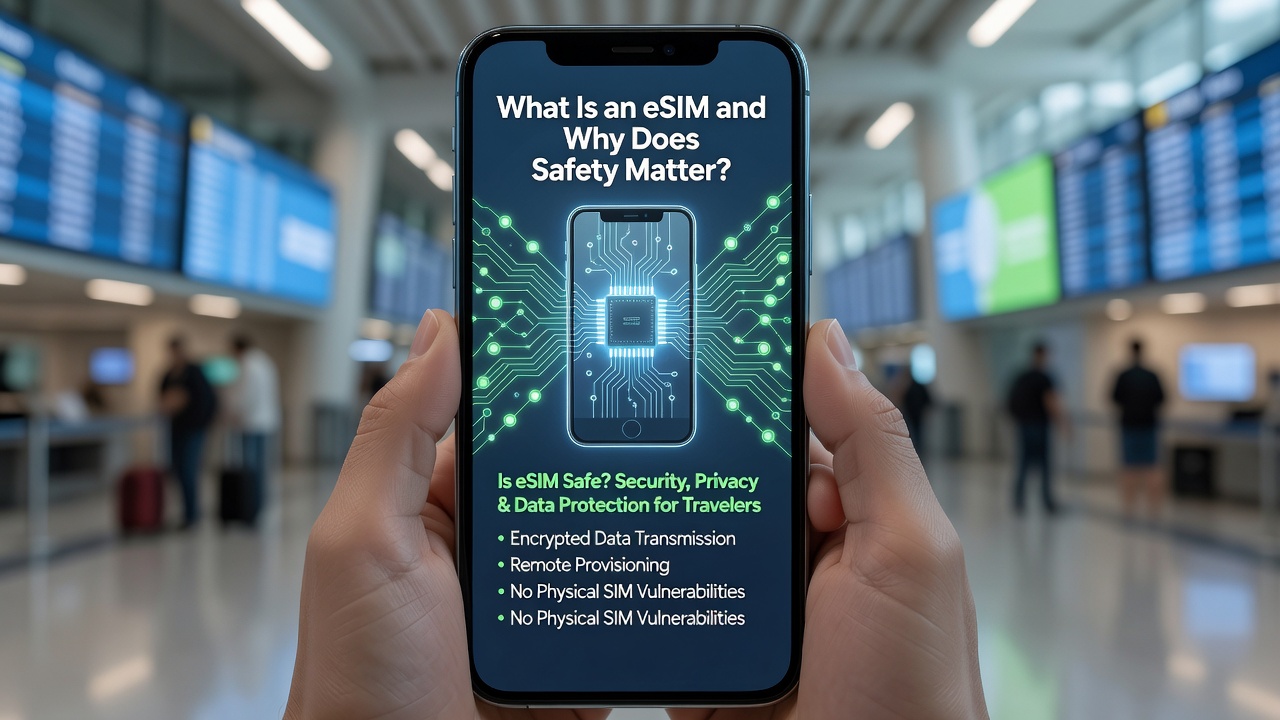
Whether you are exploring Europe eSIM coverage, hopping across Asia eSIM destinations, connecting through Africa eSIM networks, or planning a global eSIM trip across multiple continents, understanding how your digital SIM is secured helps you make informed decisions about your travel data abroad.
What Is an eSIM and Why Does Safety Matter?
If you are still exploring what is an eSIM, here is the quick version: an eSIM (embedded SIM) is a digital SIM card built directly into your phone's hardware. Instead of swapping a physical chip at every border, you download a carrier profile over the internet and activate it instantly. No kiosks, no airport queues, no fumbling with a paperclip.
But with convenience comes a natural question: if my SIM profile is downloaded digitally, is it vulnerable? The answer lies in understanding the multiple layers of protection built into eSIM technology — from the hardware chip itself to the carrier networks that serve your connection.
Encryption: How eSIM Technology Protects Your Data
Encryption is the foundation of eSIM security, and it operates at two critical levels: the profile download process and the ongoing data connection.
Secure Profile Download
When you purchase eSIM plans from a reputable provider, your carrier profile is delivered through a protected channel called the eSIM Remote Provisioning system. This process uses mutual authentication — both your device and the provisioning server verify each other's cryptographic identities before any data is exchanged. The profile itself is encrypted using industry-standard algorithms (typically AES-128 or AES-256), meaning even if someone intercepted the download, they would only see scrambled data.
This is fundamentally different from a physical SIM, which sits in a shop display or gets handed across a counter where it could theoretically be cloned or tampered with before you receive it.
Over-the-Air Data Encryption
Once your eSIM is active, your cellular data connection is encrypted using the same standards that protect physical SIM connections. Modern 4G and 5G networks use strong encryption protocols (EPS-AKA in 4G, 5G-AKA in 5G) that authenticate your device to the network and encrypt the radio link between your phone and the cell tower. This means your browsing, messaging, and app data are encrypted in transit — whether you are using a physical SIM or a travel eSIM.
For travelers looking for the best eSIM experience, the encryption standards are identical to what you would get from a local carrier's physical SIM. There is no security downgrade.
Data Privacy: How Your Personal Information Is Handled
Data privacy is where many travelers feel the most anxiety — and rightfully so. When you sign up for an international eSIM, you are entrusting a provider with your email, payment details, and device identifiers. Here is how responsible providers protect that information.
Minimal Data Collection
Unlike some local SIM registrations that require your passport, home address, and biometric data (particularly in countries with strict telecom regulations), most travel eSIM providers collect only the essentials: an email address for delivery and a payment method. You do not need to submit identity documents for most cheap eSIM plans, which actually reduces your data exposure compared to buying a local SIM in person.
GDPR and Privacy Compliance
Reputable eSIM providers comply with international privacy frameworks such as the EU's General Data Protection Regulation (GDPR). This means your personal data is stored with encryption at rest, access is restricted to authorized personnel only, and you have the right to request deletion of your data. Always check a provider's privacy policy before purchasing.
No Browsing History Logging
Your eSIM data connection routes through partner carriers, and neither the carriers nor the eSIM provider typically log your browsing history, app usage, or message content. They track data consumption (how many GB you have used) for billing purposes, but not what you are doing with that data. This is the same privacy standard as any cellular carrier.
Carrier Security: How Networks Safeguard Your eSIM Connection
One common misconception is that a travel eSIM connects through some kind of unsecured "third-party" network. In reality, your eSIM connects to the same major carrier networks that serve local residents — the difference is that your eSIM provider has negotiated roaming agreements with these carriers in advance.
Same Infrastructure, Pre-Arranged Roaming
When you use a travel eSIM in Japan, your connection might route through NTT Docomo. In Thailand, it could go through TrueMove H. In Germany, Deutsche Telekom. These are the same networks locals use every day. Your eSIM provider has already established secure roaming partnerships with these carriers, so your connection is authenticated and encrypted from the moment it connects.
If you are searching for the best eSIM for Japan or any other specific destination, the underlying security is the same — you are connecting to Tier 1 carrier infrastructure, not some shadow network.
eSIM vs Physical SIM: Which Is Safer?
Let us address the head-to-head comparison directly, because many travelers weighing an Airalo alternative, Holafly alternative, or Nomad alternative want to know if they are trading security for convenience.
- Physical theft: A physical SIM can be removed from a lost or stolen phone and inserted into another device. An eSIM is soldered to your phone's motherboard — it cannot be physically removed.
- Cloning risk: Physical SIMs have been historically vulnerable to cloning attacks. eSIM profiles use cryptographic signatures that make cloning effectively impossible.
- Activation security: Physical SIMs are activated by inserting the chip — anyone with the chip can activate it. eSIM activation requires your device's encrypted credentials, adding an authentication layer.
- Lifelong identity: Your eSIM is tied to your device hardware, not a swappable piece of plastic. This makes unauthorized transfers significantly harder.
In short, eSIM technology is not just "as safe as" a physical SIM — it is structurally more secure against physical tampering and cloning.
How to Avoid Roaming Charges Without Compromising Security
One of the primary reasons travelers switch to eSIMs is to avoid roaming charges that can run $10-$25 per MB with major home carriers. But some travelers worry that bypassing their home carrier's roaming might expose them to security risks. It does not.
When you install a travel eSIM, your home SIM line goes dormant (or stays on standby for calls while data routes through the eSIM). Your data connection is encrypted and authenticated by the local carrier just as it would be if you were paying roaming fees. The only difference is the price — and the fact that you are not handing your home carrier a blank check.
Following a proper eSIM activation guide before you travel ensures your connection is set up securely before you land, so you are not fumbling with settings on airport Wi-Fi.
5 Practical Security Tips for Travel eSIM Users
- Buy from reputable providers: Stick to established eSIM providers with transparent privacy policies and published security practices. Avoid unknown sellers on marketplace platforms.
- Activate before you fly: Download and install your eSIM profile at home over a trusted Wi-Fi connection. This avoids the risk of downloading your profile over an unsecured airport network.
- Use a VPN on public networks: Your eSIM data connection is encrypted, but adding a VPN layer provides end-to-end encryption from your device to your final destination — useful for sensitive transactions like mobile banking.
- Keep your phone locked: The biggest security risk to any traveler is physical device theft, not network interception. Use Face ID, fingerprint lock, or a strong PIN.
- Turn off your home line's data roaming: This prevents accidental charges and ensures all data flows through your secure eSIM connection. Keep your home line on standby only if you need to receive calls or texts.
Common eSIM Safety Myths Debunked
Myth: "eSIM profiles can be stolen remotely"
Reality: eSIM profile downloads require mutual cryptographic authentication between your device's eUICC chip and the provisioning server. Without physical access to your device, an attacker cannot extract or replicate your eSIM profile.
Myth: "Travel eSIMs use unsecured third-party networks"
Reality: Travel eSIMs connect to the same Tier 1 carrier networks (Vodafone, T-Mobile, NTT Docomo, Orange, etc.) that serve local residents. The eSIM provider acts as a broker, not a network operator — the underlying infrastructure is identical.
Myth: "My browsing data is visible to the eSIM provider"
Reality: eSIM providers track data consumption for billing, not content. Your browsing activity is encrypted between your device and the websites you visit (via HTTPS), and the cellular radio link is encrypted separately. The provider cannot see what you are doing online.
FAQ: eSIM Safety Questions Answered
Is eSIM safer than a physical SIM card?
Yes. eSIMs offer the same encryption standards as physical SIMs for data transmission, plus additional protection against physical theft, cloning, and SIM swap attacks. Because the eSIM is embedded in your device hardware, it cannot be removed and used in another phone without your authentication credentials.
Can someone hack my eSIM remotely?
No. eSIM profiles are cryptographically bound to your device's eUICC chip. Remote extraction or cloning is not possible without breaking the device's hardware-level encryption. The biggest remote risk to any phone is phishing and malware — not the SIM technology itself.
Does my eSIM provider see my browsing history?
No. eSIM providers track how much data you consume for billing purposes, but they do not log or monitor the content of your traffic. Your web browsing is protected by HTTPS encryption, and your cellular connection is encrypted between your phone and the cell tower.
Is it safe to buy a travel eSIM online?
Yes, provided you buy from a reputable provider. Look for providers with published privacy policies, secure payment processing (SSL/TLS), and transparent terms of service. Purchasing an eSIM online is generally safer than buying a physical SIM from an airport kiosk, where the chip may have been handled by multiple people.
The Bottom Line
For travelers wondering whether eSIM is safe, the evidence is clear: eSIM technology provides strong encryption, robust privacy protections, and carrier-grade network security — often exceeding what physical SIMs offer. The cryptographic binding between your eSIM profile and your device hardware makes it harder to clone, steal, or tamper with than a traditional SIM card.
When you choose a reputable provider, activate your profile over a trusted connection, and follow basic digital hygiene (VPN, device lock, disable home roaming), your travel eSIM is one of the most secure ways to stay connected abroad. You get the freedom of instant connectivity without the $25/MB roaming fees — and without compromising on security.
Ready to travel securely? Explore iWanteSIM plans for your next destination, check device compatibility, and read what other travelers say in our reviews. Your secure connection is one download away.